

MTX Brake Pads
Versions Tested:
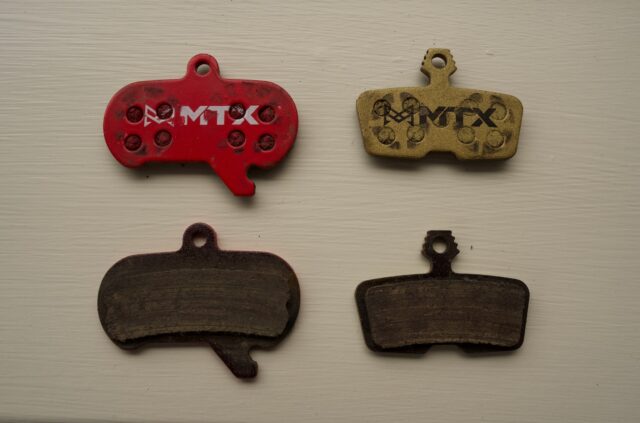
- Red Label Race pads, SRAM X-Large
- Gold Label HD pads, SRAM Large
MSRP:
- Red Label Race pads: $33 per pair
- Gold Label HD pads: $33 per pair
Bolted to:
- Red Label Race pads: Kavenz VHP 16 V7, w/ SRAM Maven Silver brakes
- Gold Label HD pads: Trek Top Fuel, w/ SRAM Motive Ultimate brakes
Reviewer: 6’, 170 lbs / 183 cm, 77.1 kg
Test Locations: Washington, British Columbia
Test Duration: 5 months
Intro
When it comes to components that can make or break a bike, brakes have to be at the top of the heap for me. In a lot of cases, I’ve found brake pads to be the key to unlocking the full potential of different braking systems. Brake upgrades can offer marginal gains over some stock pads and game-changing improvements for others, offering a different balance of traits in terms of peak power, wet weather performance, modulation, durability, etc.
MTX is a small company focused exclusively on brake pads, with two compounds — Red Label Race and Gold Label HD — on offer for a wide range of braking systems. But how do the pads perform on the trail, and how should folks think about choosing between the two options? We’ve been on the case for several months now and are ready to weigh in.

Red Label Race Pads
Before we dive in, it’s worth quickly noting that there are a whole bunch of different brake pad options out there, generally clustering into two compound types: “metallic” and “organic” (also called “semi-metallic”) compounds. You can check out David’s conversation with Galfer’s Daryl Simmons back in Ep. 81 of Bikes & Big Ideas if you want to go into the details, but in short, there is a massive amount of compound variability within each of those two groups, and it’s overly simplistic to draw conclusions about the performance of a given brake pad just based on its material type.
That nuance starts to come through in how MTX positions their Red Label Race pads. Both of MTX’s pad compounds are organic with varying formulations to prioritize different traits. With the Red Label Race pads, MTX explicitly calls out the use of CeraEVO, a specialty ceramic material, as an additive to the pad compound, along with Kevlar and other additives. The result is their “every-person’s brake pad”, which MTX says emphasizes smooth, consistent modulation and especially quiet performance.

I opted to run the Red Label Race pads with my SRAM Maven brakes. The Mavens can deliver stunning amounts of power, but all that power can be a bit difficult to control in some situations where finesse is needed. In my case, I find SRAM’s stock organic pads to feel much easier to control than the metallic option, but worse in heat management, wear, and wet-weather performance. The hope with the Red Label Race pads from MTX was to crank up the durability and wet-weather performance over the SRAM organics while also gaining even more fine control.
In most regards, the Red Label Race pads are a performance upgrade over the stock SRAM ones, at least for my preferences. They are notably quiet, but the biggest improvement in my book is their especially smooth modulation to help balance out the initial bite of the Mavens. This was especially noticeable when grip is at a premium on steep trails — both in peak summer dust and early winter slime, I felt that I could control the power curve of the Mavens a bit better with the Red Label Race pads installed.

They also seem to resist fading a touch better than the stock SRAM organics, while also lasting longer. The main weakness that I came across was in truly wet weather — while the Red Label Race pads maintain good bite at lower temperatures compared to a metallic pad, that bite seems to fall off quite a bit when it’s especially wet outside. The massive power of the Mavens helped overcome that to a degree, but I still found their performance to be best in dry conditions. Metallic pads still offer more consistent wet-weather performance, as do some other aggressive organic pads like the BLISTER-favorite Galfer Pro. On the flipside, the Red Label Race pads outperform both metallic pads at the Galfer Pro in terms of the smoothness of their power delivery and silent operation in dry conditions, particularly on the punchy Mavens.
Gold Label HD Pads
MTX positions their Gold Label HD pads as a more aggressive alternative to the Red Label Race. They’re still technically organic pads and again feature MTX’s CeraEVO additive, but come with a higher metallic content to boost heat resistance, power, and durability — things that MTX acknowledges as a priority for heavier riders or heavier bikes (think eMTBs). MTX says that the price of these benefits is increased noise and less of the especially smooth modulation of the Red Label Race.
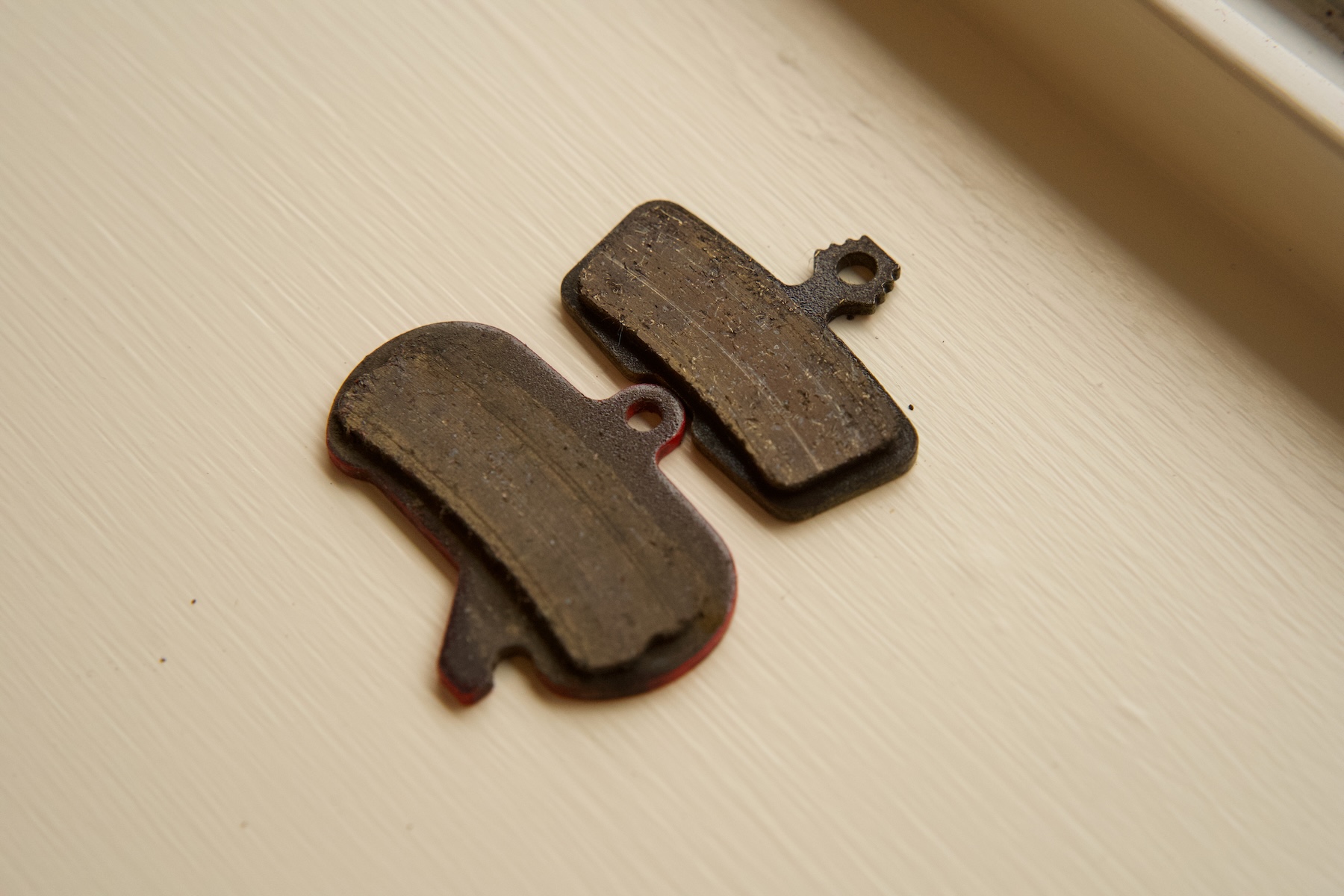
I installed the Gold Label HD pads on a pair of SRAM Motive Ultimate brakes. The Motives bring an impressively light lever feel, but their power and heat management leave a bit to be desired for more aggressive applications. The stock organic pads were far too low on power and managed heat poorly, and while the metallic pads were better on those fronts, I wanted a more punchy feel at the bite point. And if the MTX Gold Label HD could bring noise levels down over the metallic pads, too, even better.
While I enjoyed the dry conditions performance of the Red Label Race pads with the brutish Mavens, the Gold Label HD pads felt like the bigger upgrade when installed on the Motives. A lot of this comes down to the Motives being a bit underpowered for my preferences, but the faster onset of power at the bite point and much better heat resistance were very welcome improvements over SRAM’s organic and metallic pads. While the Gold Label HD pads weren’t enough to transform the Motives into some powerhouse brake, they gave the Motives a welcome boost in stopping power at lower operating temperatures while continuing to offer good bite and consistency when things got hot.

The Gold Label HD pads were also a bit better than the Red Label Race pads in wet weather. Perhaps it’s down to the higher metallic content, but the Gold pads didn’t have the same falloff in bite that the Reds did when the rotors were wet. They still aren’t standouts in terms of soggy conditions performance, falling slightly behind the stock SRAM metallic pads when trails were truly soaked, but they still far outperformed the stock organics.
While the Red Label Race pads wore quite well, the Gold Label HD pads take things up a notch in the durability department, with plenty of life left after several months of riding time. One of the big downsides of true metallic pads is noise, and the Gold Label HD pads are still far quieter than SRAM metallics, but they can’t match the near-silent dry conditions operation of the Red Label Race compound. The Galfer Pro pads are still the best brake pads I’ve used in terms of maximizing power output and aggressive bite, but they wear far, far more quickly than the Gold Label HD pads.

Bottom Line
It’s helpful to think of brake pads as a way of tuning brake performance. In use, MTX’s Red Label Race pads helped to smooth out the power delivery of my SRAM Maven brakes, while the Gold Label HD pads helped to level up the power and heat management of the SRAM Motives.
MTX has come to market with two brake pads that can offer considerable performance gains over stock options. The Red Label Race and Gold Label HD pads seem to offer meaningfully differentiated performance, with the Reds prioritizing smooth and silent power delivery, while the Golds bring a more noticeable increase in power and heat resistance. While neither would be my top choice for wet-weather performance, they’re impressive performers in most conditions with long pad life that helps make them a solid value, too.
I stumbled upon MTX red pads when the pickings were slim in 20/21. Much to my surprise, I loved them and continue to use them exclusively.
I think they are the perfect Goldilocks pad for the everyman rider. I don’t ride in the wet, so any performance reduction there goes unnoticed.