

Öhlins RXF36 m.3
Wheel Size Options: 27.5’’ and 29’’
Travel Options:
- 27.5’’: 150, 160, and 170 mm
- 29’’: 140, 150, and 160 mm
Available Offsets:
- 27.5’’: 38 and 44 mm
- 29’’: 44 and 51 mm
Stanchion Diameter: 36 mm
MSRP: $1,245 / €1,569 (w/ VAT)
Blister’s Measured Weight: 2,019 g (29’’, 160 mm travel)
Reviewer: 6’, 160 lb / 183 cm, 72.6 kg
Bolted To: Specialized Stumpjumper 15, We Are One Arrival 152
Test Duration: 7 months
Test Locations: Washington, British Columbia
Intro
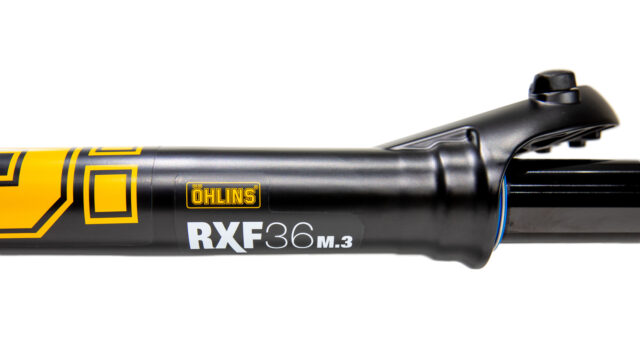
Öhlins has been expanding their MTB presence over the last few years, and now offers a complete suspension lineup from XC to DH. So with their product range filled out, it’s perhaps not a great surprise that they’ve turned their attention back to the longstanding RXF36 Trail bike fork, and given it an update. Let’s see what’s new in the RXF36 m.3.
Design & Features
The biggest changes to the RXF36 come in the chassis. As the name suggests, it still has 36 mm stanchions, but Öhlins has shaved a little weight from the chassis (bringing the new fork to a stated weight of 2,050 g, down from our measured weight of 2,111 g for the m.2 generation). They’ve also managed to increase the bushing overlap (presumably aided by the fact that the maximum allowable travel has been reduced to 160 mm for the 29’’ fork and 170 mm for the 27.5’’ one). Öhlins’ floating, bolt-on 110×15 mm axle design carries over from the RXF36 m.2.
Those tweaks make sense, given that the prior-generation RXF36 m.2 predated the burlier RXF38 m.2. As we’ve seen from a lot of other suspension manufacturers, Öhlins has effectively taken their formerly-burliest single crown offering, supplanted it with a 38mm stanchion version, and then made the smaller / lighter version a more dedicated Trail bike fork for greater differentiation.
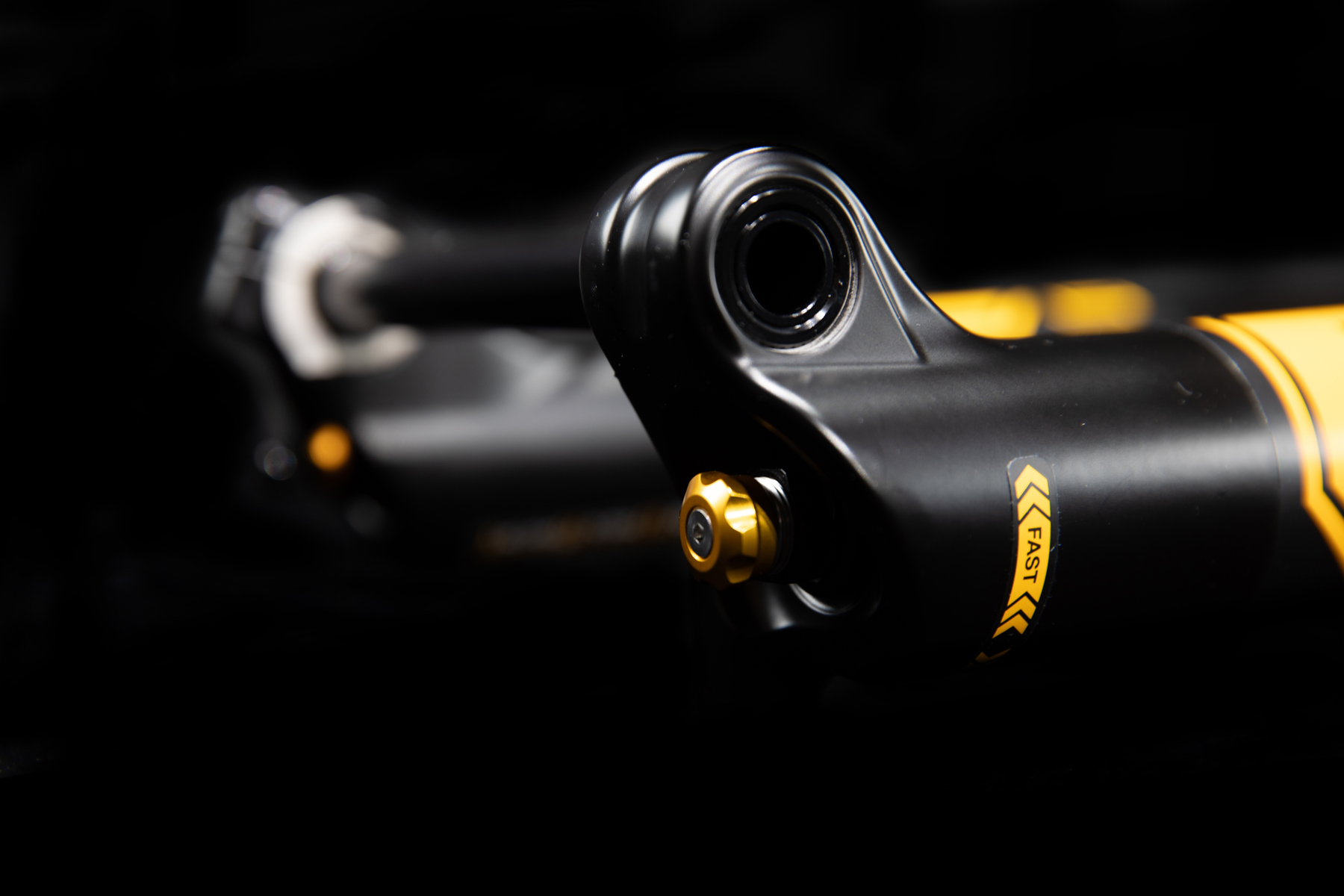
Öhlins also says that they’ve made some tweaks to their stanchion finishing procedure to reduce friction and that the new CSU assembly can be used with either an air or coil spring assembly. That means that all of Öhlins’ forks from the RXF36 on up can be converted back and forth between the two spring layouts as desired.
[Check out our review of the coil spring conversion kit for the RXF38 m.2 for more on how those options compare.]
Spring Design
The RXF36 m.3 still uses the same three-chamber spring design with two independently adjustable positive chambers and a self-equalizing negative one, but some of the details have been tweaked.
For those who aren’t familiar, the RXF36’s air spring uses a dual-positive chamber layout, with the two stacked on top of each other, with a floating piston separating the two. The secondary “ramp up” chamber runs substantially higher pressure than the main one, only coming into play once the pressure in the main chamber equals that of the ramp up chamber. Once that happens, the piston separating the two moves as the fork compresses farther, effectively combining the two chambers into a single higher-volume one. The idea is to make the fork ramp up more quickly than a conventional single-positive chamber design would through the middle part of the travel for increased support, without continuing to do so as aggressively deeper in the travel. By varying the relative pressures in the two chambers, you can change where in the travel that inflection point occurs, and thereby change the shape of the spring curve in ways that aren’t possible with a more conventional volume spacer arrangement.
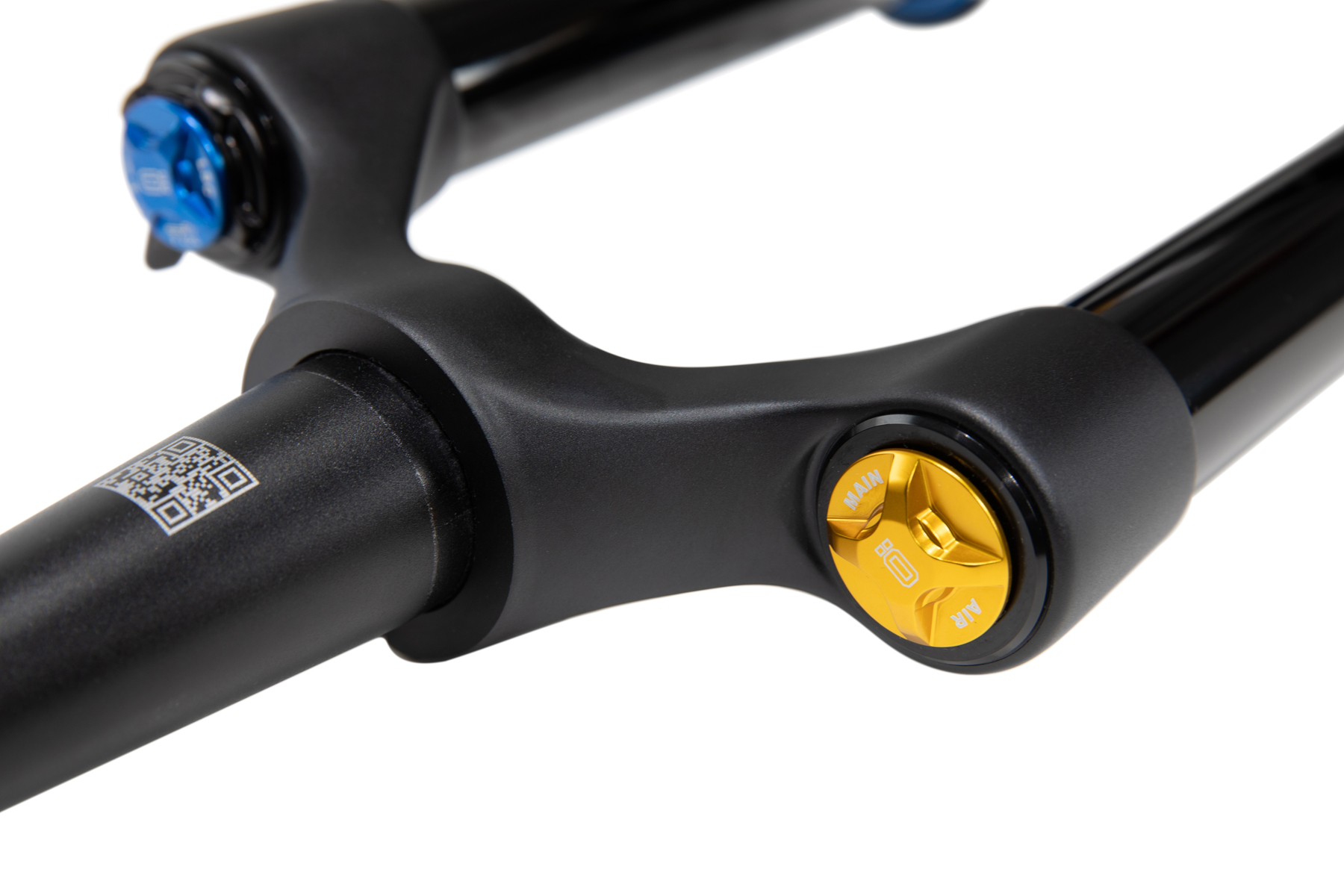
That’s still all true of the RXF36 m.3 spring, too. Öhlins has changed the default configuration of the spring by removing the negative volume spacer that came installed on the m.2 generation fork and adding a larger main chamber spacer to tweak the overall spring curve in the stock configuration, but the spring assembly itself is otherwise the same (and you can swap an m.2 fork to m.3 spec or vice-versa by swapping the spacers around).
Öhlins isn’t offering a coil-sprung version of the RXF36 directly (at least for now) but will have an aftermarket kit available to make the swap should you want to.
Damper
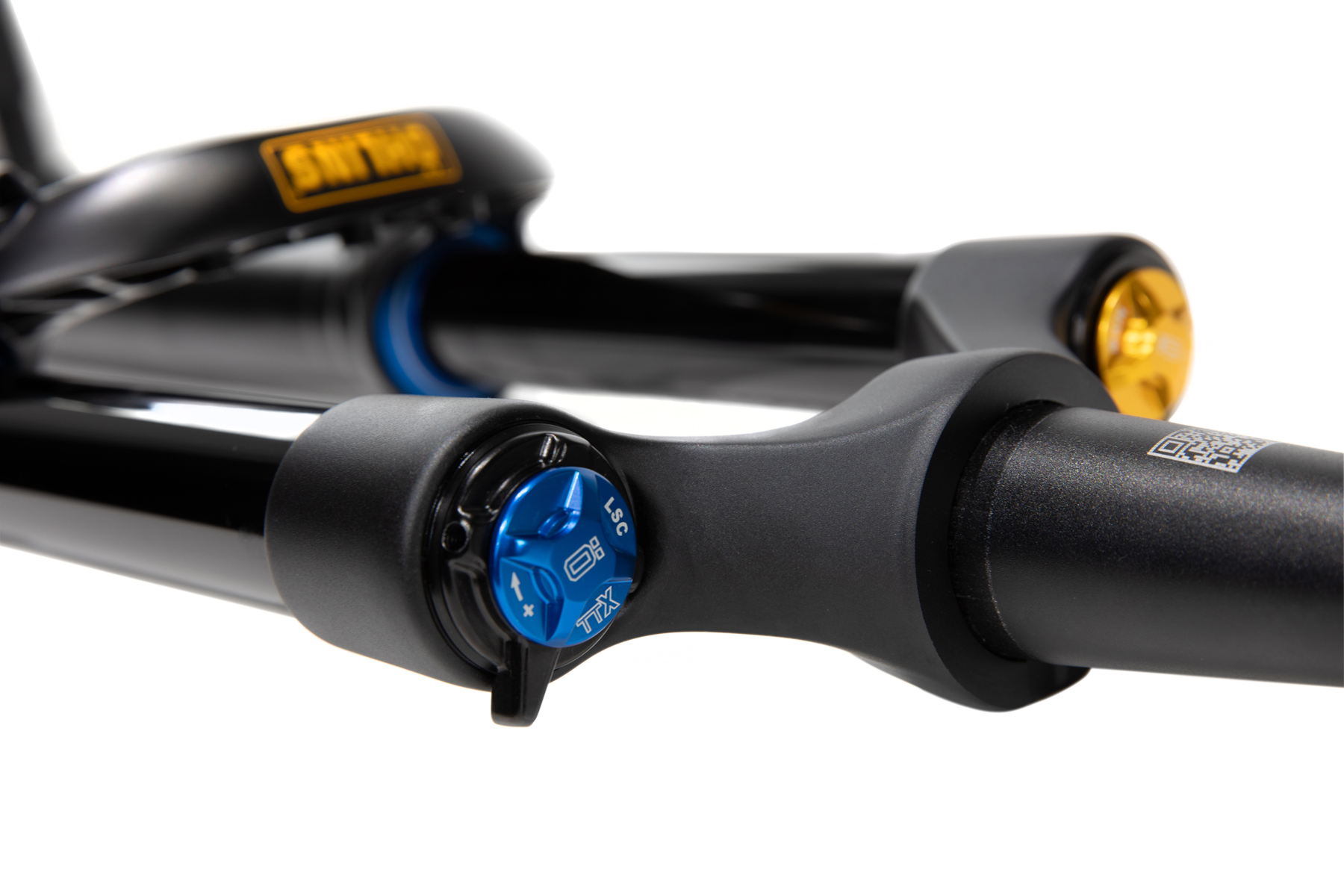
Öhlins’ longstanding TTX18 twin-tube fork damper carries over to the RXF36 m.3 as well. It’s still got adjustable high- and low-speed compression and low-speed rebound, with a firmer climb mode activated by switching to the firmest setting on the high-speed compression adjuster.
Öhlins has given the RXF36 m.3 version a lighter rebound tune than the one that was featured on the outgoing m.2 version (which was on the slower side of things), but the damper carries over unchanged otherwise. A whole bunch of our reviewers have been impressed by the TTX18 damper in a variety of Öhlins’ forks over the years, so we aren’t complaining about the changes to that side of things being modest. It’s a good damper. As they say, If it ain’t broke, don’t fix it.
FULL REVIEW
The Öhlins RXF36 m.2 was tasked with covering a notably wide range of use cases, from Trail through Enduro when it first launched a while back. It was offered with travel from 130 to 170 mm travel stock, with options to extend it up to 180 mm with an aftermarket spring tube, or even go as low as 90 mm travel for dirt jump duty. It was a very good fork, but its chassis felt a little undergunned at the longer-travel end of that range — and Öhlins clearly agreed, because the RXF38 followed a bit later, offering a beefier (and heavier) chassis for longer-travel applications.
So, when Öhlins rolled out the latest m.3 generation RXF36, they had an opportunity to narrow its focus to the Trail / All-Mountain realm, and make some other refinements to its design in the process. Here’s our take on how it has shaken out.
[We’ve only tested the RXF36 m.3 Air so far, but a coil version is also available. For our thoughts on the tradeoffs between Öhlins’ air and coil spring designs, check out our review of the RXF38 m.2 Coil, which shares its spring designs with the RXF36.]
Setup
Between having a second air chamber to fiddle with and the not-entirely-intuitive ways that the relative pressures in the two chambers interact, dual-positive air-sprung forks can be tricky to set up. Happily, the tweaks that Öhlins made to the air spring in the RFX36 m.3 have smoothed out its air spring curve and made it easier to work with. The RXF36 m.2 was already somewhat more straightforward than many other dual-positive forks, and the tweaks to the m.3 have only widened that gap.

That said, I’ve consistently found Öhlins’ recommended fork air pressures to be quite low, and that’s the case here as well. Their chart suggests a baseline of about 95 psi main / 185 ramp pressures; I settled on 107 and 225 (with the fork set to 160 mm travel). I wind up running a little over recommended pressure in a lot of forks, but not usually by such a wide margin.
I’ve had similar experiences with a variety of Öhlins’ forks over the years, and I was able to get things dialed in relatively quickly. The re-configuration of the air spring in the RXF36 m.3 helped there. I’ll cover its performance in greater depth in a minute, but the stock spacer configuration in the new fork leaves a wider range of tuning options without an abrupt-feeling change in the spring curve at the point where the ramp-up chamber comes into play. The performance of the m.2-generation spring layout was great with the right setup, but it was pretty easy to make it feel funky deep in the stroke if things weren’t dialed in; the m.3 is much more forgiving on that front.
I’ve found the lighter stock rebound tune in the RXF36 m.3 to be an improvement, too. In the m.2, I was running the rebound toward the faster end of its range; I’m much closer to the middle on the m.3. No single tune is going to work perfectly for every rider out there, and some heavier folks who prefer slower rebound settings might find the newly lightened tune to be lacking, but the updated tune in the m.3 strikes me as a better middle ground for the majority of riders out there.
On the compression side, I’ve found myself mostly running the high-speed compression one click from closed (excluding the climb position) and the low-speed around -7. Öhlins maintains a sizeable tune database, and the RXF36 can be revalved to achieve a lighter or firmer adjustment range as part of a damper service if desired.
On-Trail Performance
The RXF36 m.3 feels like a refinement of the m.2 generation fork rather than something entirely different — which checks out, given the ways its design has and hasn’t changed.

The prior-generation RXF36 Air stood out for being a relatively supportive, composed-feeling fork with generally firmer damping than a lot of its competitors. That’s broadly true of the m.3 version, too, but it doesn’t feel like such an outlier in today’s market. Some of that is down to changes to the RXF36’s competitors (most notably Fox dropping the lightly-damped Grip2 VVC damper in the 36 in favor of the Grip X2 one), but the tweaks Öhlins made to the RXF36 m.3 have smoothed some of its rougher edges, too.
As I already touched on in the “Setup” section above, the refinements to the air spring tuning play a big role here. The small bump sensitivity of the RXF36 m.3 Air is notably better than the m.2 version, and it’s easier to avoid the fork feeling like it has an abrupt change in spring progression when the ramp-up chamber comes into play. I’m able to get the midstroke support and bottom-out resistance I want from the m.3 with a slightly lower ramp-up-to-main-chamber-pressure ratio, and the RXF36 m.3 feels a little more consistent for it.
Dual-positive air springs are primarily intended to make it easier to set up a fork for good mistroke support without making it unduly stiff early in the travel and/or so progressive that using full travel is a challenge, and the implementation in the RXF36 m.3 does that quite well. It’s a particularly strong option for folks who prioritize a composed-feeling ride and keeping the fork up in its travel, while still maintaining good compliance and grip.
The potential tradeoff for some folks is that it’s trickier to make the RXF36 m.3 feel super soft through the middle part of the travel, with a big progressive ramp up at the end to stave off bottom-outs. I also think that’s a setup that far too many people run, and that most folks would be better off with a more linear spring curve — which the RXF36 m.3 enables nicely — but if you find yourself running lots of volume spacers and relatively low pressure in most forks, the RXF36 Air might not be for you. (But, seriously, I think that kind of setup is a mistake most of the time.)
Apart from the overall faster rebound range I touched on earlier, the RXF36 m.3’s damper feels very much like that of the m.2 — which I’m not complaining about. If it ain’t broke, don’t fix it, etc. It’s an especially good damper for folks who’d like to run relatively firm compression settings — it’s able to make a good bit of damping on the stock tune, and does so without getting harsh and spiky and high shaft speeds especially effectively — but it’s also not that heavily damped at the open end of the range. Mostly, it’s just a very good, reasonably adjustable damper with a slightly firmer compression tune than some of its competitors. I’d still be perfectly happy if Öhlins dropped the climb mode from the high-speed compression knob — I really don’t see much need for them on anything other than true XC bikes — but having it there and ignoring it isn’t too big a deal.

The RXF36 m.3’s chassis also feels a little stiffer than the m.2 version, particularly fore-aft. It’s not a massive difference, and the RXF36 is, unsurprisingly, not as stout as the RFX38 and its heavier, 38mm-stanchioned brethren, but it’s a noticeable improvement nonetheless. I suspect that the increased bushing overlap of the m.3 chassis deserves a lot of the credit — enabled, at least in part, by the fact that the RXF36 m.3 tops out at 160 mm travel (for the 29er version; the 27.5’’ one can go up to 170 mm), as compared to 180 mm for the m.2.
Some folks have bemoaned the loss of longer-travel options in the 35-36 mm stanchioned class of All-Mountain forks in recent years, as the 170+ mm travel bracket has been taken over by the 38 mm stanchioned big guns. That’s understandable for lighter and/or less aggressive riders who don’t want to tote the extra weight of the bigger forks around, but it’s also become clear to me that manufacturers have been able to make big gains in fore-aft stiffness, in particular, by narrowing the allowable travel window for this class of forks, and making the bushing overlap correspondingly longer.
[The longer the maximum travel for a given fork, the more you need to either lengthen the stanchions and extend the lowers to accommodate that extra travel — thus adding weight — and/or move the lower bushing up, reducing the bushing overlap. Both the RXF36 and Fox 36 have made big gains in fore-aft stiffness in their latest chassis iterations, while keeping similar weights to the versions they replaced.]
The RXF36 m.3’s chassis doesn’t feel quite as stout as the latest Fox 36, but it’s close — and well within a range that I’m happy with for this sort of fork. If anything, the RXF36 m.3 feels a little stiffer fore-aft than the current RockShox Lyrik, but that difference is also slight. More generally, chassis stiffness (and weight — they’re all close there, too) wouldn’t be how I’d decide between the three. The more meaningful differences are in their actual suspension performance.

Broadly speaking, I’d characterize the Lyrik as offering the most distinct ride feel of the three; the 36 and RXF36 are somewhat more similar to each other than they are to the Lyrik. The RXF36 m.3 is the easiest of the three to get great midstroke support from, with the 36 not too far behind, while the Lyrik feels more oriented toward a plush, muted ride feel at the expense of some support and chassis stability.
Both the 36 and RXF36 are also able to generate more compression damping at medium to high shaft speeds without getting spiky and harsh at times. Once again, the RXF36 does so a bit more than the 36. None of that is to say that the Lyrik is a bad fork by any stretch; rather, it just takes a different tuning philosophy than the other two. The RXF36 m.3 is the most supportive and composed of the three; the Lyrik does the best job of muting out small chatter, and the 36 lands in between.
Reliability & Servicing
I’ve found the reliability of Öhlins’ forks to generally be quite good in recent years, and the RXF36 m.3 hasn’t given me any trouble. I’ve done one lower leg service on it so far, as a matter of routine maintenance rather than having a specific need to do so, and all the original seals and such are still going strong. The CSU has remained creak-free, and I’ve had no other issues to report.

The biggest limitation to the RXF36 m.3 from a user-serviceability standpoint is that Öhlins doesn’t publish a manual for servicing the TTX18 damper at home. The service kits are available, and an intrepid DIYer can figure it out, but it’d be nice to have that workshop manual publicly available.
Otherwise, the RXF36 m.3 is straightforward to work on. Doing a lower leg service isn’t meaningfully different from most modern forks. Servicing the air spring takes an extra shaft clamp, due to the cartridge-based design, but it’s easy with the right tools.
Bottom Line
Öhlins has done a nice job updating the RXF36 with the latest m.3 generation version, without messing with what made the m.2 good in the first place. It’s still a fork that’s going to appeal most strongly to folks who prioritize a supportive, composed setup, but the new version does so while offering better small bump sensitivity, a bit easier air spring setup, a more usable rebound adjustment range, and a slightly stiffer chassis — while also being fractionally lighter. It’s not a fundamentally different fork so much as it’s a refinement of an already good one. Sometimes that’s plenty, and this is one of those cases.
In the minority, I’m sure, but I love that Ohlins offers a damper of this quality and performance AND includes a climb switch.