

Shimano XT M8200 Di2 Drivetrain
MSRP:
- Shifter: $190
- Derailleur: $570 (Derailleur only; Battery: $55 / Charger: $45)
Cassette: $195
Crank: $190; Chainring: $73
Chain: $62
Blister’s Measured Weights:
- Shifter: 97 g (I-spec version)
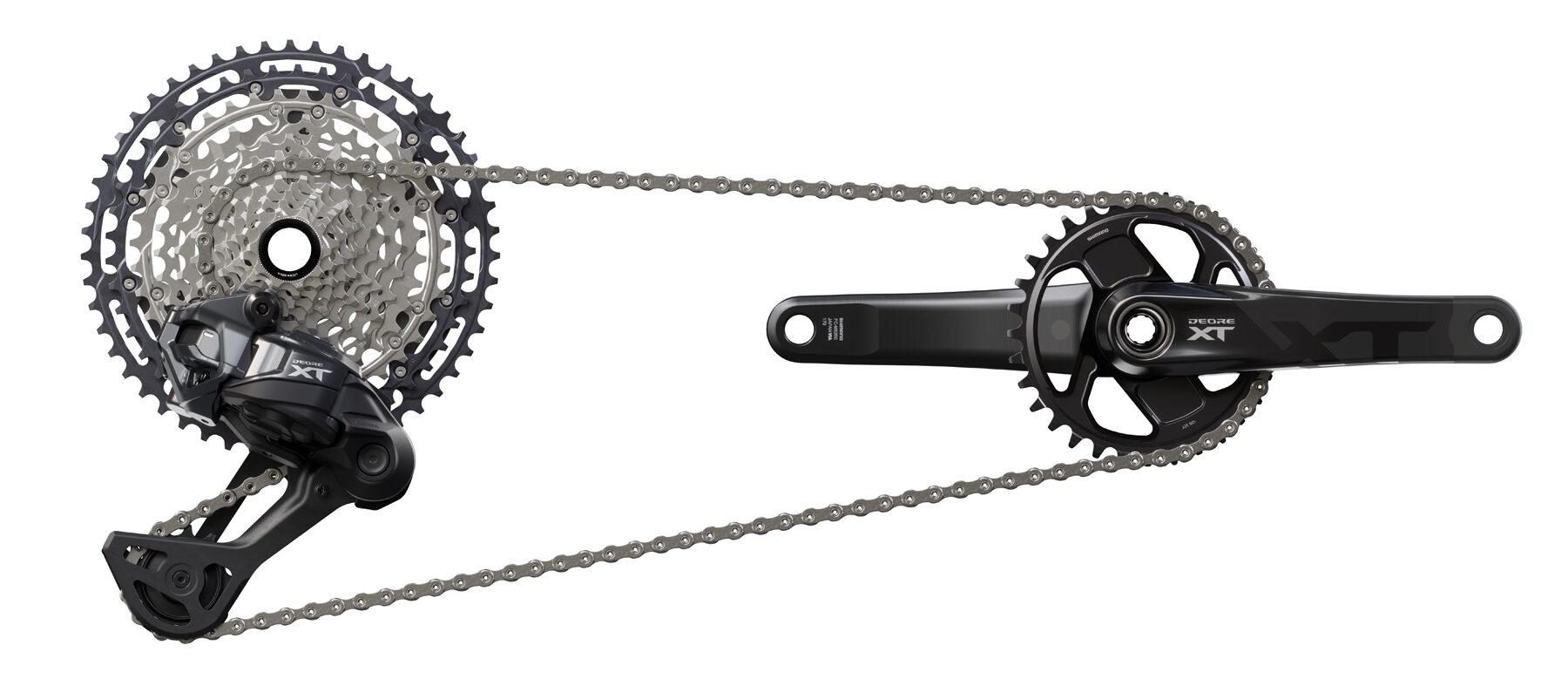
- Derailleur: 448 g (GS short cage) / 452 (SGS long cage) + 27 g (battery)
- Cassette: 420 g (9-45 tooth) / 457 (10-51 tooth)
- Crank: 525 g (170 mm arms) + 73 g (30 tooth chainring); 598 g total
- Chain: 281 g (126 links, full length)
Reviewer: David Golay (6’, 160 lb / 183 cm, 72.6 kg)
Bolted To: Contra MC, We Are One Arrival, Nicolai G1, Trek Fuel EX, Pivot Firebird
Test Duration: 4 months
Test Locations: Washington, British Columbia
Intro
Shimano launched its long-awaited 12-speed Di2 MTB groups at the flagship XTR tier (as expected), but more affordable XT and Deore versions followed surprisingly shortly thereafter. The XTR version of the group is excellent, so how close would the XT version get in performance? XT has historically been a bit of a sweet spot in Shimano’s lineup, offering high-end performance for a lot less money than its XTR counterpart, so I was eager to find out.
[For all the design details of the new group, and its more affordable Deore sibling, check out our First Look on the pair; we’ll be focusing on the on-trail performance of the XT Di2 group here. We, unfortunately, haven’t been on the Deore version yet.]
On-Trail Performance
Overall, the performance of the XT Di2 groupset has been quite good, and quite similar to that of the XTR version I reviewed earlier. There’s not a whole lot to separate their shifting performance overall; I’ll touch on some of the finer points where they differ in a minute, but in terms of shifting speed and smoothness, they’re quite close.
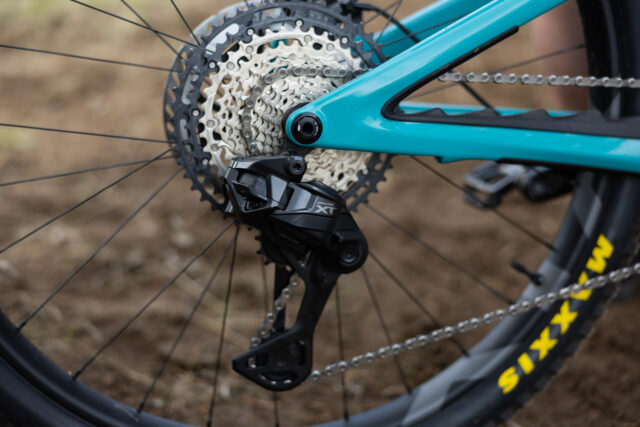
Which is to say that the XT Di2 setup shifts great. The feel is reminiscent of Shimano’s 12-speed mechanical groups in terms of how the chain moves across the cassette — probably unsurprisingly, given that they use the same chain and the cassettes are cross-compatible. It’s extremely smooth if you back off the power a touch, particularly when downshifting; shifting accuracy remains good under load, but there’s a bit more noise, and the action doesn’t feel quite as silky as it does if you back off a touch.
It only takes a very slight easing on the pedals to make for quite smooth shifts, though, and the shifting accuracy of the XT Di2 group is excellent. On the mechanical version, it’s possible to make the chain skip if you try to downshift too many gears too quickly; the electrified version does an excellent job of running through a bunch of gears in short order without such hiccups.

SRAM’s Transmission groups — the wireless AXS versions, especially — shift with more of a solid thud. There’s less variation in their shifting smoothness between shifts under light load vs. full power, but the XT Di2 group feels a bit smoother and quieter when moderately loaded. And, while SRAM has bumped up the speed at which the AXS Transmission derailleurs can run through a bunch of gears via firmware updates, the Shimano Di2 groups are still substantially quicker if you want to execute multiple shifts at once.
That’s all very much in keeping with the mechanical XT 12-speed group, too. The main difference between the two is the actuation — the shifter feel and ergonomics are different.
But, as with the XTR Di2 shifter, the XT one is a lot closer to a mechanical shifter in layout and feel than you might expect, especially if you’re familiar with SRAM’s decidedly non-shifter-like AXS controllers. What’s “better” ergonomically is admittedly subjective, but I vastly prefer Shimano’s approach to electronic shifter design.

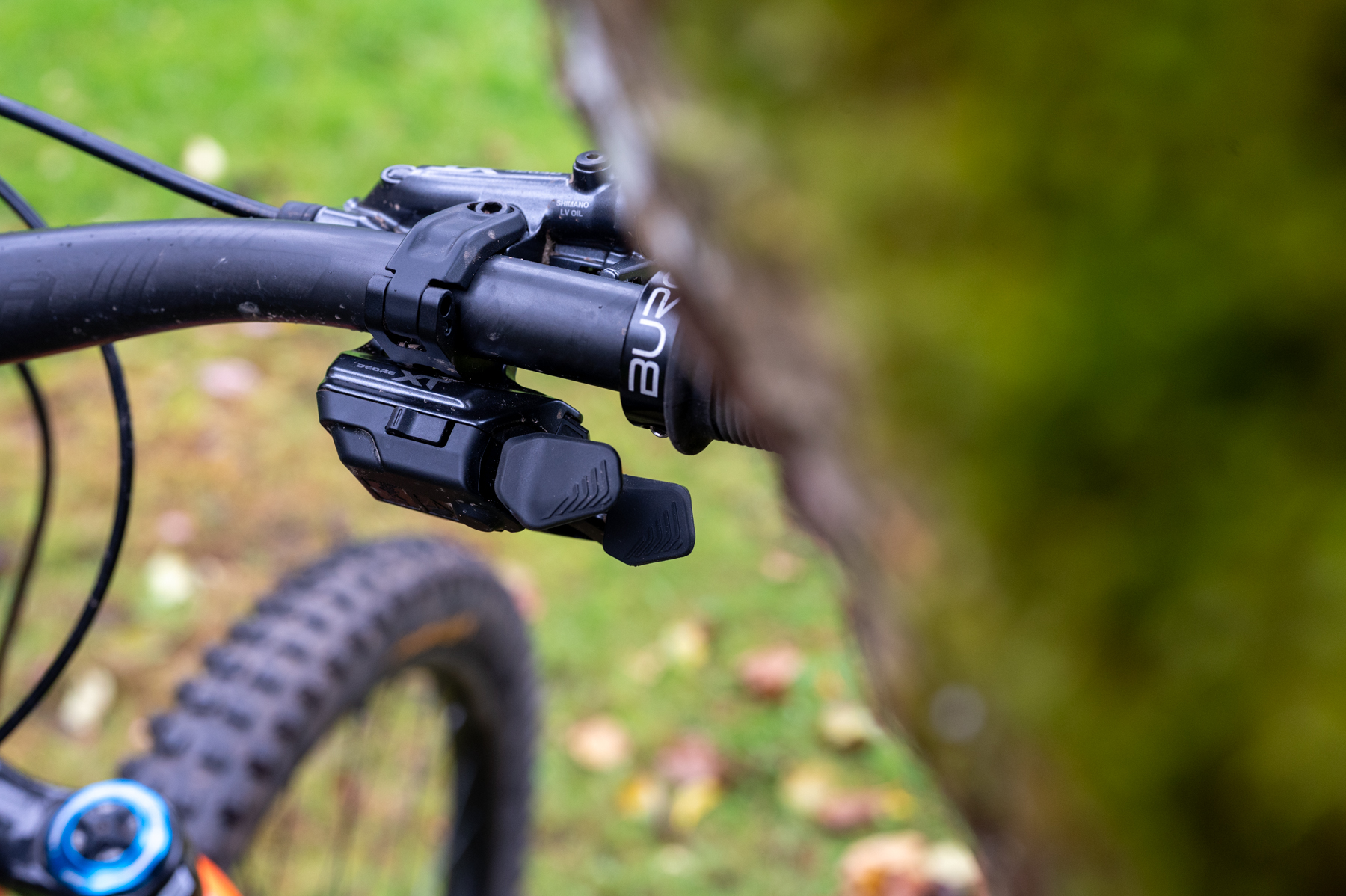

With the XT shifter, I still disable the second click in the phone app; the difference is that, unlike doing it mechanically on the XTR shifter, the second click is still physically present. That’s nearly as good a solution for me, though I have occasionally pressed through to the second click and momentarily thought I shifted twice when I felt the second detent. I’d personally probably spend the extra $30 for the XTR shifter for that feature, though if you’re going to leave the second click enabled, the differences between the two mostly disappear. The lower/forward paddle on the XTR shifter feels a tiny bit crisper in its actuation, too, but it’s a slight difference and only really noticeable when handling both back to back. I’d be hard-pressed to tell the difference on trail.
Gearing Options
I’ve spent a lot of time on both the 10-51 and 9-45 tooth versions of the XT drivetrain. There’s not much difference between the two in terms of shifting performance, but the 9-45 one is notably quieter. I haven’t had issues with dropping chains on any of the versions of the new Di2 groups that I’ve tried so far (across a fairly wide range of bikes now), but the spring-based chain stabilizer that Shimano switched to on the new derailleurs seems to result in more audible chain slap than the clutch-based designs of old.
How relevant (or not) that is depends a lot on the bike in question. On the Nicolai G1, for example, there’s not much audible chain slap regardless of drivetrain version; the Trek Fuel starts to be a bit noisy with the long cage setup. The shorter derailleur cage of the 9-45 version makes a noticeable difference on that front, providing better chain management and less noise. It’s also a little lighter and adds a bit of ground clearance, both at the derailleur and the chainring (assuming you change the chainring size to keep the overall gearing range similar).

There are a few potential downsides to the 9-45 tooth setup. For one, it requires a proprietary lockring tool, since the nine-tooth small cog doesn’t leave room for a standard one. Shimano’s tool works nicely (and Abbey has a version of their excellent Crombie tool for the new lockring, too), though both are only compatible with 12mm through axle hubs, so if you want to put the 9-45 tooth setup on a bike with an older axle standard, you’re out of luck. Some hubs also lack the clearance for the smaller lockring (e.g., the Industry Nine 1/1 and Hydra require an updated end cap to work, and Hadley is a no-go).
Keeping the overall gear range (nearly) consistent between the two cassette options also means sizing down by four chainring teeth for the compact cassette, and not every bike has clearance to go down as small as some folks might prefer to. Shimano also doesn’t offer a chainring smaller than 28 teeth, though there are some third-party options for various cranks that go smaller.
If it fits, though, I’m a fan of the 9-45 version. It’s quieter, lighter, offers about the same gearing range, and the derailleur cage is a little farther from harm’s way, with few downsides apart from the potential compatibility pitfalls. Going to a smaller chainring will also have some impact on the suspension kinematics of a given bike (generally higher anti-squat and correspondingly more pedal kickback), though the magnitude of those changes will vary a lot depending on the bike in question.
Weight Breakdown: XT vs. XTR
There’s not a lot to separate the XT and XTR groups when it comes to shifting performance, so how about weight? The XTR bits are undeniably shinier, and the group is (unsurprisingly) lighter, but by how much? And where do the weight savings come from?

The cassette, first and foremost. The 10-51 tooth version of the XTR cassette is 90 grams lighter than the XT one, per our measured weights. We haven’t yet gotten our hands on a 9-45 tooth XTR cassette, but I’d expect the gap to be a touch wider for the compact versions, since the 9-45 XT uses a single aluminum cog and 11 steel ones, vs. two aluminum / ten steel for the 10-51 version, whereas the XTR cassette gets three aluminum cogs, five titanium ones, and four steel ones regardless of gearing. Shimano’s stated weights (which are commendably accurate for the parts we have weighed) bear that out, with a stated 99-gram weight savings for the XTR version of the 9-45-tooth cassette.
The XTR derailleurs are also about 60 grams lighter than their XT equivalents. But, interestingly, the XTR crank isn’t lighter than the XT one, at least if you compare the XTR M9220 Enduro version to the lone XT model.
The main reason, apparently, is the spindle: the XTR M9220 Enduro crank uses the same arms as the M9200 XC version, but with a beefed-up, stiffer spindle (which a Shimano employee referred to as “Richie Rude spec”). The XT crank arms and chainring are heavier than the XTR ones, but are paired with the lighter spindle option. The result is that an XTR M9220 crank with a 32-tooth chainring weighs almost exactly the same as an XT one with a 30-tooth ring (170 mm arms for both). The XTR M9200 XC crank should be appreciably lighter, but Shimano doesn’t have a stated weight available for it, and we haven’t gotten our hands on one.

I don’t doubt that the beefier XTR M9220 spindle is stiffer than the XT one, but I haven’t found it to make much of a difference for me on trail. I’m also not particularly heavy and don’t tend to be very sensitive to crank stiffness, so your mileage may vary there. Both the XT and XTR M9220 cranks feature a slightly wider Q-factor (176 mm) than I personally prefer, but that’s fairly typical by modern standards (e.g., SRAM’s T-Type cranks come in at 174 mm, apart from the narrow 168 mm version of the XX SL one).
Durability & Maintenance
There’s a lot I like about Shimano’s mechanical 12-speed groups, but the derailleurs aren’t the most resilient to impact damage. I’ve had a few take hits that left them generally intact and not visibly mangled, but tweaked just enough to lose shifting accuracy; the XT Di2 derailleur is a big improvement there in my experience. It shrugged off some small to medium impacts wholly unscathed and survived one especially brutal rock strike — one hard enough that the whole bike hung up momentarily and pitched me off balance — with only superficial damage. I was sure I’d destroyed it from the way the impact felt, but only needed to tweak the micro adjustment by a couple of clicks to compensate for the slightly bent derailleur hanger that resulted. I’m confident that the mechanical version wouldn’t have fared nearly as well.
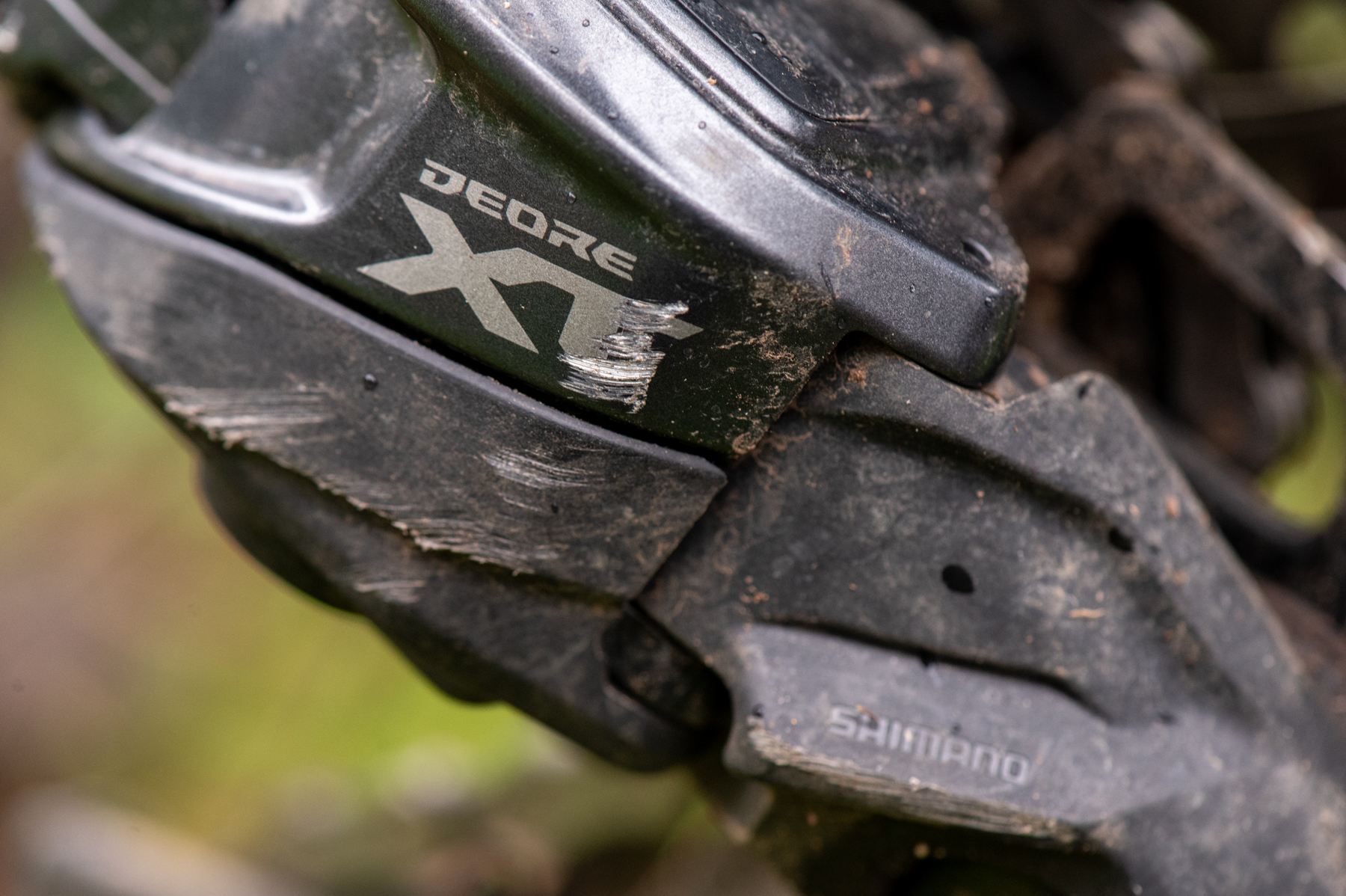
I’ve also found the battery life of the Di2 groups to be quite good. I’ve yet to need to replace any shifter batteries, and the derailleur ones have been getting me through around 30 hours of ride time on a charge — a noticeable, if not massive, bump up over SRAM’s AXS T-Type derailleurs.
Who’s It For?
I’m not really going to argue that anyone needs electronic shifting. Mechanical derailleurs are undeniably the better bang-for-buck option for folks on a budget, and for most applications, I’d rather have high-end suspension and a more basic drivetrain than the other way around, for example.
But the XT M8200 group works very well, and has some real upsides over its mechanical counterparts. The shifter ergonomics are outstanding; it shifts more accurately and requires less regular adjustment than most mechanical systems, and the derailleur has proven to be impressively robust. If you’re into electronic shifting, and especially if you’ve found SRAM’s controller options to be ergonomically lacking, the XT Di2 group is an excellent option.

Bottom Line
The Shimano XT Di2 group does a commendable job of bringing most of the performance of its flagship XTR sibling to a more manageable price point. The XT Di2 group gives up a little weight, a bit of bling, and a few bells and whistles compared to the XTR version, but their shifting performance is extremely similar — and very, very good. The long-cage 10-51 tooth version isn’t the quietest, with a fair amount of chain slap on some frames, but the 9-45 tooth option is a significant improvement, and saves a little weight and adds some ground clearance in the process.
Are the MC, G1, and Arrival all your personal rigs? That’s a wild quiver of seemingly overlapping bikes? Even so, what a drool-worthy boutique lineup: steel, aluminum, and carbon. Plus that sweet BTR Ranger.
Yeah, that’s the current quiver. The Arrival 152 is pretty different from the two big bikes (as is the BTR, obviously). The MC and G1 overlap a lot in terms of intended use, but ride pretty differently.
Ah I see, so the Arrival occupies something of a middle-ground space. Very cool, thank you!