

Enve M8 & M9 Pro Wheels
Intended Use: Gravity
Internal Width:
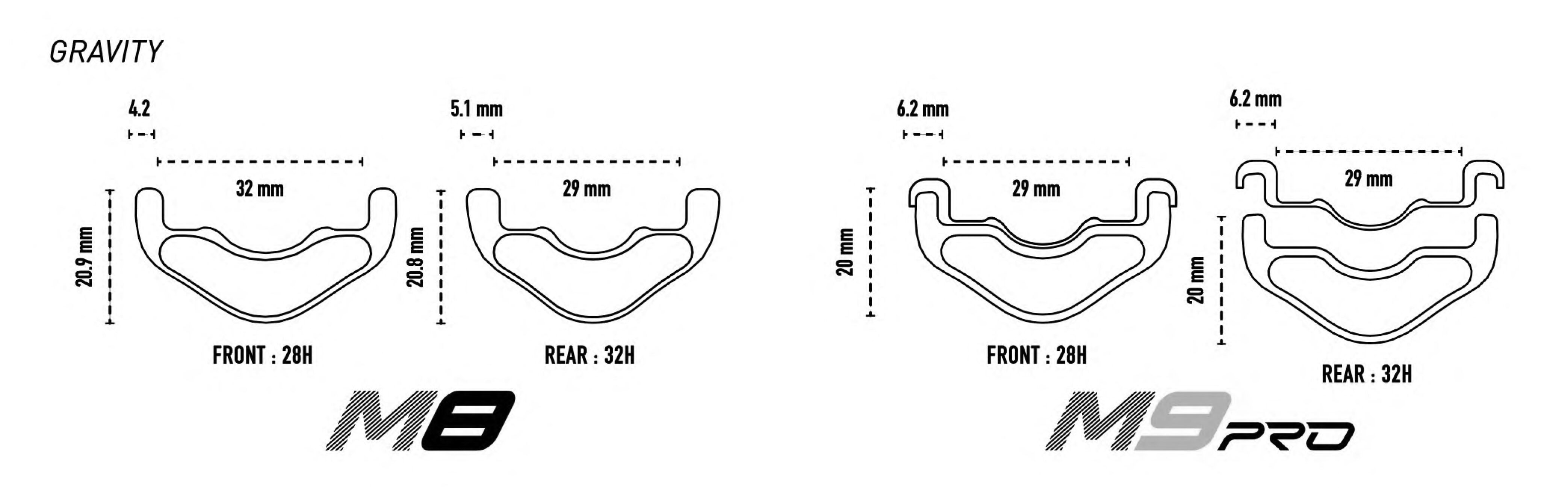
- M8: 32 mm (front) / 29 mm (rear)
- M9 Pro: 29 mm front & rear
Versions Offered:
- Front:
- 29’’ only
- Centerlock + 15 x 110 mm Boost
- 6-bolt + 20 x 110 mm Boost (convertible to 15 x 110 mm Boost)
- Rear:
- 27.5’’ or 29’’
- Centerlock or 6-bolt
- 12 x 148 mm Boost or 12 x 157 mm Super Boost
Blister’s Measured Weights:
- M8 29’’ Front, 20 x 110 mm 6-bolt: 988 g
- M8 29’’ Boost Rear, 6-bolt, MS driver: 1,123 g
- M8 Wheelset: 2,111 g
- M9 Pro 29’’ Front, 20 x 110 mm 6-bolt: 1,101 g
- M9 Pro 27.5’’ Boost Rear, Centerlock, MS driver: 1,164 g
- M9 Pro Wheelset: 2,265 g
MSRP:
- Front Wheel: $1,035
- Rear Wheel: $1,265
- Wheelset: $2,300
Bolted To: Geometron G1, Contra MC
Reviewer: 6′, 160 lb / 183 cm, 72.6 kg
Test Locations: Washington, British Columbia
Test Duration: 11 months
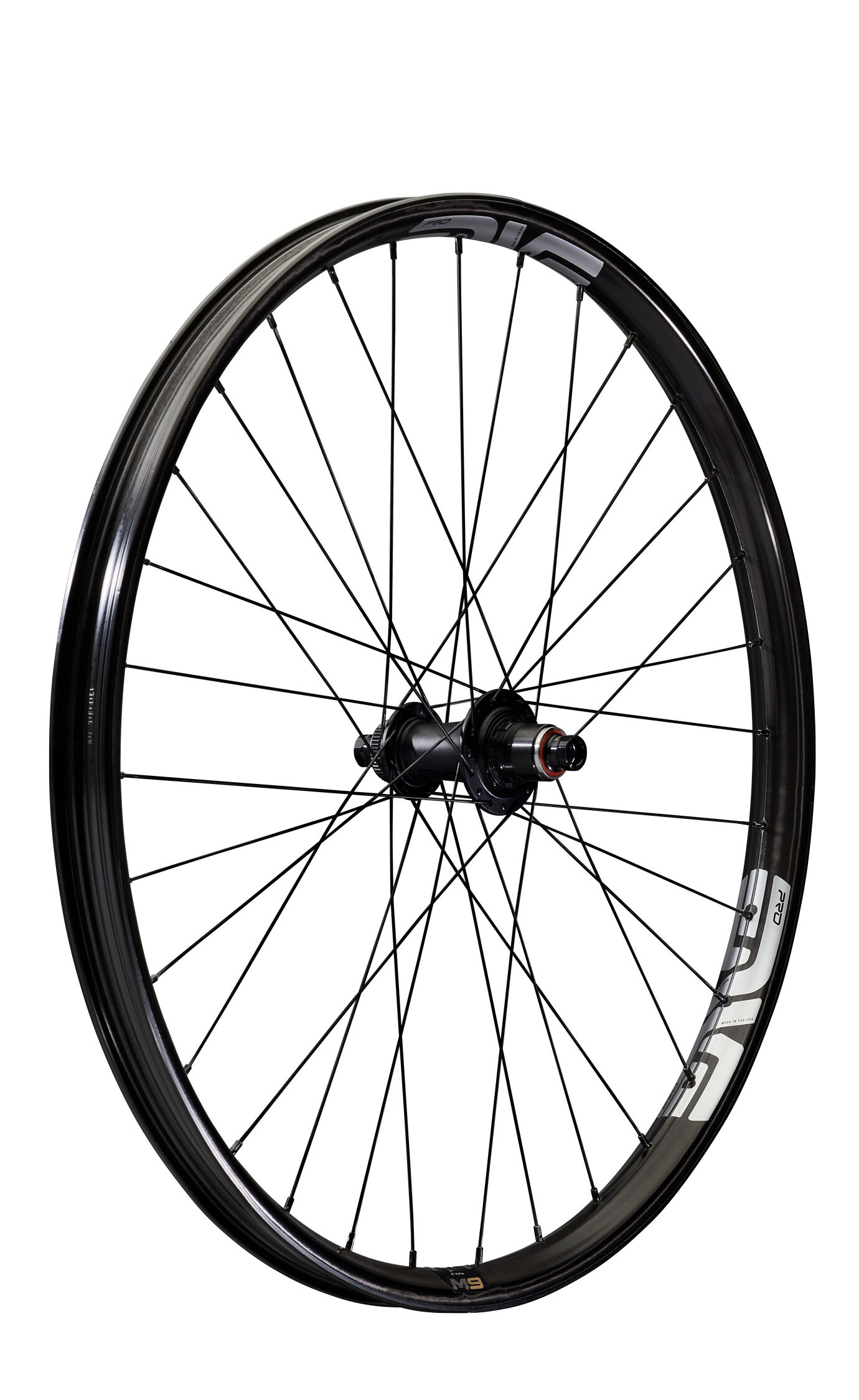
Intro
Enve’s now-prior-generation M-Series wheels had grown quite long in the tooth by the time the new fifth-generation versions rolled out in late 2024. As Enve’s VP of Product, Jake Pantone, laid out in Ep.243 of Bikes & Big Ideas, the evolution of bike design and rider needs over that time changed Enve’s design goals for the new wheels in a big way.
The M8 and M9 Pro are the two gravity-oriented options in Enve’s lineup. We’ll get into the differences in design and performance of the two below, but Enve blurs the line between the two in terms of intended use, with both recommended for Enduro / DH riding, depending on your exact priorities.

Earlier iterations of Enve’s M-Series wheels have been notably stiff, and making the new versions more compliant was at the top of the priority list for the new versions. The M6 Trail wheels we already reviewed are indeed much, much less stiff than the M630 that came before it, but Enve’s claims for the M8 and M9 Pro wheels are even more dramatic. The M6 rims are stated to be about half as stiff as the M630 ones; the M8 rims are claimed to be 73% less stiff vertically and 47% less stiff laterally than Enve’s prior Enduro rim, the M730, and those numbers climb even further to 77% / 64%, respectively, for the M9 Pro vs. the outgoing M930 DH rim.
Those are wild numbers. So, how do the M8 and M9 Pro wheels ride, and how do they stack up — both against each other, and the rest of the high-end gravity wheel market? I’ve spent almost a full year finding out.
Design
We already covered the design of the new M-Series lineup in our First Look, but we’ll recap it here. There’s a lot of overlap in the design of the M8 and M9 Pro wheels, so we’ll start with the similarities:
Per usual for Enve, the M8 and M9 Pro rims are made from carbon fiber in Enve’s own facility in Utah, and use dedicated designs for the front and rear rims. The exact dimensions differ a bit (more on that in a minute), but all four rim versions have notably shallow cross-section thicknesses with a pinched profile to the sidewalls to help reduce the overall stiffness of the rims.
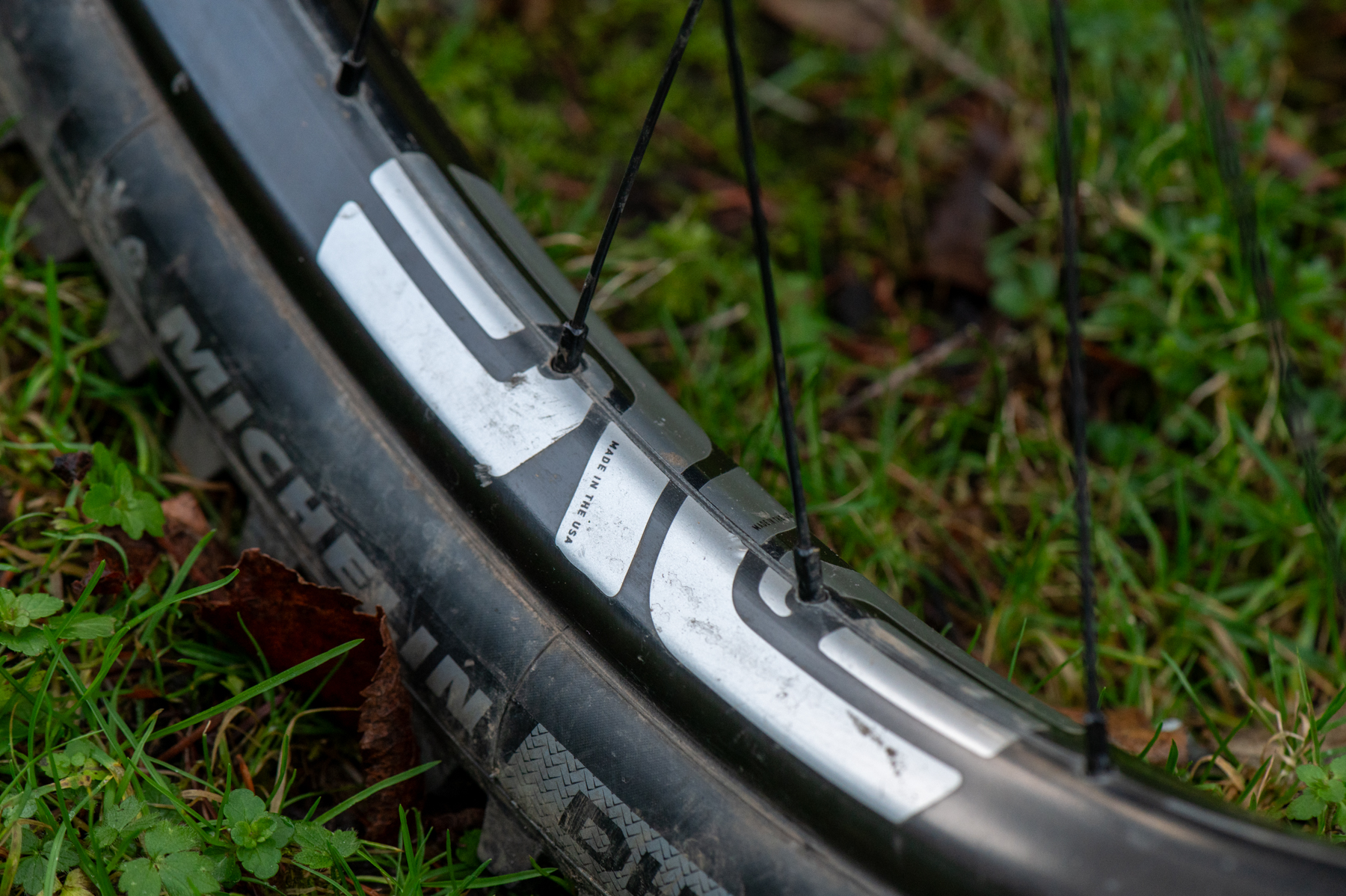
The front wheels are offered in a 29’’ diameter only, but the rear wheels are available in both 27.5’’ and 29’’ versions. The new M-Series wheels also feature Enve’s own Innerdrive hubs, rather than being offered with a variety of third-party options. The Innerdrive hubs use a star ratchet system with 80 points of engagement in stock form, with 40, 60, and 100-tooth ratchet rings offered separately. Both ratchet rings and the spring that drives them together are housed in the hub shell and retained with a snap ring, so that there aren’t loose parts to spring free when taking the hub apart. The axle uses threaded end caps to hold everything together, with a wave spring automatically adjusting the bearing preload.
Unlike the lighter-duty M-Series wheels, the M8 and M9 Pro use versions of the Innerdrive hubs with conventional J-bend spokes (28 front / 32 rear). Sapim Sprint spokes are used throughout, paired with brass nipples. Those nipples are now conventional external ones, in contrast to the internal nipples used on the earlier M-Series wheels — truing the wheels or replacing a spoke (thankfully) no longer requires removing the tire and rim tape.
Both wheels are available with six-bolt or Centerlock rotor mounts and 12 x 148 Boost or 12 x 157 mm Boost rear spacing. The six-bolt front hub comes with a 20 x 110 mm axle as standard, but a 15 x 110 mm conversion kit is available; the Centerlock front hub is compatible with a 15 x 110 mm axle only, since the Centerlock rotor interface doesn’t leave enough room for a 20 mm one without resorting to smaller bearings than Enve is happy with.

The biggest difference between the M8 and M9 Pro rims is that the M8 ones use conventional rim tape, while the M9 Pro ones use Enve’s molded polyurethane rim strip, which wraps over the bead wall, in addition to sealing off the spoke holes instead of conventional rim tape.
The idea is that the rim strip affords some extra protection for the rim and helps prevent pinch flats by padding the interface between the rim wall and the tire. The rim strip can also supposedly maintain a seal with a rim that has cracked, but not failed catastrophically, to allow the rider to finish a race run.
The main tradeoff to the rim strip is weight: neither the M8 nor the M9 Pro rims are particularly light, but the M9 ones (including the rim strip) are claimed to be about 125 grams heavier apiece, with the M8 rims coming in just under 600 g each, and the M9 Pro ones around 720 g (29’’ diameters across the board, varies slightly between the front and rear versions). Adding rim tape to the M8 reduces the differential by a few grams, but it’s still sizable. Our measured weight difference for M8 and M9 Pro front wheels in the same spec, with rim tape included on the M8, is 113 grams.
Mounting & Installation
It’s pretty rare for modern rims to present any notable challenges when installing and seating tires, and the inner profile of both the M8 and M9 Pro rims has worked nicely with a variety of tires I’ve tried on them from Michelin, Continental, and Maxxis.
That said, I ran into two minor hiccups setting up the M9 Pro wheels. First, the rim strip on one wheel came out of the box with a sharp edge where the flash from the molding process hadn’t been trimmed cleanly; a quick pass with a box cutter sorted that out. Enve’s supplied tubeless valves are also a very tight fit in the rim strip; they work, but the base of the valve sits pretty high and makes it a little harder to mount a tire, since you need to get the first bead over the base of the valve. It’s workable, but I used Reserve Fillmore valves (which I continue to be a huge fan of) to make my life easier.
I still think the rim strips make for a less fussy, more reliable interface overall, though. Rim tape is light, but it’s also easily damaged, and installing it (while not hard) is one of my least favorite bike maintenance tasks. The rim strips used on the M9 Pro wheels are much, much beefier than any rim tape I’m aware of. I don’t feel the need to be as careful when using tire levers on the M9 Pro rims as I do when there’s a risk of damaging rim tape with them, and the fact that the rim strips wrap over the bead walls of the rim seems to make the seal at the bead more robust, too.
I haven’t broken a spoke on the M9 Pros, but I’m also confident that there’s little chance of a broken spoke puncturing the rim strip, which can’t be said of normal rim tape. There’s a weight penalty for the system, but a real reliability improvement / faff reduction from it, too.

Mounting & Installation
Getting tires out on the trail starts with getting them mounted, and my experience has been that both the Delium options I’ve tried take a little more effort to seat and seal than average, but aren’t too hard to work with. If you’ve got an air compressor, seating them is easy; doing it with a high-flow floor pump is doable, but it takes a little extra effort to pump quickly.
Getting the tires to seal fully also took some extra time and care, but once I got there they’ve been solid. The Reinforced casing just seems a little more porous than some of its competitors and required a few rounds of sloshing sealant around the tire to get a good seal. Since that initial setup, they’ve held air normally and haven’t taken bigger / more regular top-ups than other average.
It’s also worth noting that the lighter of the two Versatile tires I’ve tried gave me the most trouble in getting a good seal by a long shot. That particular tire is substantially lighter than the the other sample in the same spec that I’ve tested, and undercuts Delium’s stated weight by a fair bit, too. It makes some sense that a notably light sample would get there by having a little less rubber in it, and might end up less fully airtight out of the box for it. I was able to get the other two tires I’ve tried to seal with a normal amount of sealant but the light one took a bit extra.
Ride Quality & Performance
The M8 and M9 Pro wheels have a lot in common in terms of ride feel. I’m going to refer to them collectively when covering their shared attributes, and differentiate between the two where needed.
The new wheels feel nothing like Enves of old. Earlier iterations of the M-Series wheels have been stiff to a fault; the M8 and M9 Pro are among the most compliant, smoothest riding carbon gravity wheels I’ve ridden. I won’t claim to be so well calibrated that I can assess Enve’s claimed stiffness reductions down to the percentage point, but the new wheels are clearly much, much less stiff than the prior-generation M-Series ones — and I think they ride far better for it.
Wheels don’t flex nearly enough to absorb large impacts, of course, but a more compliant wheel makes a real difference in how sharp the beginning of a square-edged hit feels, before the suspension can really start moving and take over. Both the M8 and M9 Pro tamp down that sort of harsh feedback notably well.

Enve’s published data says that the M9 Pro rims are slightly more vertically compliant and a touch stiffer laterally than the M8 ones, but those differences feel pretty subtle on trail — I’d be hard pressed to tease out any real differences in stiffness between the two. I’d characterize both as being notably compliant vertically (particularly for carbon wheels), and more middle-of-the-road laterally. It’s a nice combination, with both variants offering a particularly muted ride feel while still delivering a bit more lateral stiffness and precision than a lot of less stiff aluminum options.
Weight is the most noticeable on-trail difference between the M8 and M9 Pro wheels. The heavier M9 Pros, unsurprisingly, feel a little slower to spin up (e.g., when sprinting out of a corner) and sap a bit more energy while climbing. But the added weight of the M9 Pro rims also makes the bike feel a little more settled and planted at speed — in ways that I didn’t necessarily expect, but came to appreciate in the right circumstances.
To put it bluntly, the M9 Pro is the heaviest carbon wheelset I’ve ridden. While that might sound like it defeats the point of springing for carbon wheels, my time on the M9 Pro wheels has actually helped convince me otherwise, at least for gravity-oriented applications. Riding the M8 and M9 Pro wheels back-to-back on the same bike, with the same tires on both, the M9 Pro setup felt noticeably less prone to deflecting off stuff and pinging around — particularly through high-speed, off-camber impacts.

To be clear, that’s not a knock on the M8 wheels. They track a little more smoothly than some lighter, stiffer options (e.g., DT Swiss EXC 1200), and, again, are notably compliant and muted in their ride feel. The M9 Pro wheels just feel a notch more settled yet, and while the added weight of the M9 Pro also makes the bike feel a little less lively/responsive (especially at speed, when they’re really turning quickly), that planted, muted feel pays real dividends in the right terrain.
Interestingly, what I didn’t notice was much of an impact on suspension performance. In theory, the added unsprung weight of the heavier wheels should make the suspension feel a little less responsive to square-edged hits, but any changes there felt outweighed by the more planted feel from the heavier M9 Pro wheels. The Geometron G1 that I used as the main test platform feels more settled at speed with the M9 Pro wheels bolted up, especially over medium-sized chatter.
Maybe it shouldn’t come as such a surprise that the added unsprung weight doesn’t feel very impactful — the weight difference between the M8 and M9 Pro rims works out to less than a 4% increase in the weight of the total wheel package (wheels + tires + rotors + cassette), even before accounting for other sources of unsprung weight (fork lowers, derailleur, frame swingarm, etc.). That’s not to say that unsprung weight categorically doesn’t matter or anything like that, but directly comparing the M8 and M9 Pro wheels was pretty eye-opening for me about the ways wheel weight does and doesn’t matter. Climbing is unequivocally more pleasant on lighter wheels, but the tradeoffs get a lot more nuanced when it comes to descending, especially at higher speeds.

So, why bother with relatively heavy carbon wheels then? Ride feel, for one. Both the M8 and M9 Pro manage to feel quite muted and smooth, while also being a bit more lively and responsive than any comparable aluminum wheel I’ve been on. But, especially for gravity race usage, I think durability and reliability are big reasons to go carbon.
Durability & Maintenance
I’ve been on the same set of M9 Pro wheels for almost a full year now, and they’ve held up to a ton of abuse without incident. I’ve given the rear wheel a light truing / re-tensioning, but it was still rolling fine; I haven’t touched the front. The hub bearings are still in great shape, the freehub mechanism is impressively clean, and I haven’t even managed to pinch flat a tire on them, despite some hard rim strikes. Aluminum rims are practically disposable on DH bikes under aggressive riders; Enve claims to have gone an entire World Cup DH season without a qualifying or race run lost to rim failure with the M9 Pro wheels, and I’ve personally had great results with their durability.

It’s hard to say with total certainty that a given impact would or wouldn’t have killed a tire on a different wheel, but Enve’s claim that the rim strip on the M9 Pro wheels helps stave off pinch flats seems to have some validity. It certainly makes sense that they’d help — between the extra surface area they add to the bead wall and the bit of give in the semi-rigid rim strip, there’s much less of a sharp edge to cut tires than there is on a lot of other wheels.
I’ve spent a bit less time on the M8s, but they’ve held up well for me, too. I have pinch flatted one Continental Kryptotal DH tire on them (with a bad rock strike that resulted from going too deep pulling for a gap over a hole at speed), but the wheel survived without incident.
I’m also still a fan of Enve’s new Innerdrive hubs. House brand hubs carry an (often deserved) stigma, but unlike most, these aren’t just rebranded catalog hubs from an overseas supplier. Enve clearly put a lot of effort into the hub design, with very good results. The Innerdrive hubs roll quickly, are well sealed (especially the freehub mechanism), and are quite easy to work on. I’ve only taken them apart to swap between 15 and 20 mm front axles and to experiment with the different ratchet parts — the bearings are still in great shape, and I haven’t needed to do any actual service on the hubs.
My take on the different ratchet options hasn’t changed since my review of the M6 wheels a while back, so I’ll just quote that bit here:
The one knock I have is that the stock 80-tooth ratchet is louder than I’d like. It makes a relatively pleasant sound — much less high-pitched and buzzy than an Industry Nine Hydra, for example — but they’re far from silent. Adding some grease to the ratchets only made a modest difference.
The optional 60-tooth ratchet, while still not ultra-quiet, is far more so than the 80-tooth one, and the 40-tooth version is a little quieter still (the difference between the 40- and 60-tooth ratchets is much smaller than that between the 60- and 80-tooth ones). As you’d expect, the tone also gets a bit lower and more rumbly as you step down in points of engagement.
The 60-tooth version hits the sweet spot for my preferences. I like that it’s much quieter than the 80-tooth version, and I don’t miss the extra 20 points of engagement at all. I’m happy riding the 40-tooth one, too, but the quicker pickup of the 60-tooth version can be nice in certain technical climbing situations, and the reduction in noise in going from the 60-tooth ratchets to the 40-tooth ones is fairly modest. Enve also offers a 100-tooth version for folks who’d prefer faster engagement and/or a louder hub. I haven’t tried the 100-tooth version, but Enve acknowledges that the higher engagement ratchets are louder, and that trend seems clear from the three variants that I tried.

Bottom Line
Enve historically hasn’t been known for making compliant, smooth-riding wheels, but they’ve completely reversed course with their new M-Series lineup. Both the M8 and M9 Pro (as well as the M6 Trail wheels that we already reviewed) are notably compliant, muted-feeling options that have held up to an impressive amount of abuse without incident.
The decision between the M8 and M9 Pro should be a pretty simple one for most folks: the M8 is a still-burly wheel that’s a bit lighter than the M9 Pro; the M9 Pro is the move if you want the added reliability of Enve’s rim strip system and an even beefier rim, and are okay with adding about 110-120 grams per wheel for it. The added weight of the M9 Pro actually has some advantages when it comes to composure at speed in rough terrain, too, but the overall ride feel of the M8 and M9 Pro wheels is more similar than it is different — and at least for my preferences, both are excellent.