

Ski: 2026-2027 Dynastar M-Free 112, 183 cm
Available Lengths: 183, 190 cm
Blister’s Measured Tip-to-Tail Length (straight-tape pull): 181.7 cm
Stated Weight per Ski (183 cm): 2200 grams
Blister’s Measured Weight per Ski (183 cm): 2256 & 2271 grams
Stated Dimensions: 141-112-133 mm
Blister’s Measured Dimensions: 140.5-110.5-132.5 mm
Stated Sidecut Radius (183 cm): 21 meters
Measured Tip & Tail Splay (ski decambered): 63.5 mm / 52 mm
Measured Traditional Camber Underfoot: 7.5 mm
Core Materials: poplar/PU + titanal binding plate + fiberglass laminate
Base Material: sintered HD Base
Factory Recommended Mount Point: –3.4 cm from center / 87.5 cm from tail
Ski: 2026-2027 Dynastar M-Free 112, 190 cm (click to expand specs)
Blister’s Measured Tip-to-Tail Length (straight-tape pull): 189.6 cm
Stated Weight per Ski (190 cm): 2300 grams
Blister’s Measured Weight per Ski (190 cm): 2404 & 2405 grams
Stated Dimensions: 141-112-133 mm
Blister’s Measured Dimensions: 140.5-111-132.5 mm
Stated Sidecut Radius (190 cm): 22 meters
Measured Tip & Tail Splay (ski decambered): 61 mm / 46 mm
Measured Traditional Camber Underfoot: 6.5 mm
Factory Recommended Mount Point: –3.4 cm from center / 91.4 cm from tail
Test Location: Crested Butte, CO
Days Skied: ~20
[Note: Our review was conducted on the 24/25 M-Free 112, which returns unchanged for 25/26 and 26/27, aside from the graphics.]

Intro
Last season, several of our reviewers got on two lengths of Dynastar’s M-Free 112, and it was a standout ski for all of us.
Building off the success of their M-Free 100 and M-Free 108, the M-Free 112 was added in the 2024-2025 season as the biggest ski in the freeride collection. Dynastar hasn’t messed with its construction since, though it does get new graphics for 26/27; keen-eyed viewers will have noticed them under the feet of Dynastar’s newest athlete, WeiTien Ho, when he podiumed at the first stop of the Freeride World Tour this season.
However, there’s a lot more to this ski’s story than simply being a wider variant of the other M-Free models, so let’s dive right in:
What Dynastar says about the M-Free 112:
“Open bowls, deep trees and big hits. The Dynastar M-Free 112 F-Team skis are all in with the float, agility and control you need for full-speed-ahead skiing. From laying fresh tracks to sticking your landings, they offer a stable yet agile platform for getting creative anywhere the snow leads you. Their Progressive Rocker profile and Adaptiv Sidecut respond to fast-paced skiing with a playful feel, while our Hybrid Core delivers a smooth ride in all conditions. Wide arcs in open terrain or quick slashes in the trees, the M-Free 112 has a free spirit that's ready to explore.”
— Dynastar
Construction
The M-Free 112 utilizes Dynastar’s “Hybrid Core 2.0” construction. It’s a combination of poplar wood and synthetic PU, but in contrast to the original Hybrid Core used in the first M-Free skis, version 2.0 places the wood stringers longitudinally, vertically, and transversally, with the goal of reducing the need for additional fiberglass and adhesive (in turn, reportedly decreasing its environmental impact).
Shape & Rocker Profile
The M-Free 112’s shape and rocker profile are pretty different from the other M-Free models. The 112 is more symmetrical overall, and it doesn’t feature as much tapering at the ends of its tips and tails. For a playful ~110mm-wide ski, the M-Free 112’s rocker lines aren’t wildly deep, but it does feature a pretty true ‘twin tip,’ and it’s cambered through the middle of the ski.
The M-Free 112 looks very similar to a ski from Dynastar’s sister brand, the Rossignol Sender Free 110. In fact, our measured dimensions for both skis are all within a few millimeters of each other; they also share the same stated sidecut radii and have nearly identical rocker profiles. Despite these similarities, our on-snow experiences on these two skis have been notably different, as we’ll touch on below.
Flex Pattern
Here’s how we’d characterize the flex pattern of the 183 cm M-Free 112:
Tips: 6-6.5
Shovels: 7-7.5
In Front of Toe Piece: 8-10
Underfoot: 10
Behind the Heel Piece: 10-8.5
Tails: 8-6
And here’s how we’d characterize the flex pattern of the 190 cm M-Free 112:
Tips: 6-7
Shovels: 7.5-8
In Front of Toe Piece: 8.5-10
Underfoot: 10
Behind the Heel Piece: 10-8.5
Tails: 8-6
These skis are pretty strong overall, but they do soften up a good bit in the rockered portions of their tips and tails.
Compared to the similar-looking Rossignol Sender Free 110, the M-Free 112 has a pretty similar flex pattern, but it’s a bit softer at the ends of the ski.

Sidecut Radius
At 22 meters for the 190 cm length, the M-Free 112’s stated sidecut radius is fairly long, but not particularly unusual for a freeride ski this wide.
Mount Point
The M-Free 112’s recommended mount point is about -3.5 cm from the true center of the ski. That’s quite centered and in line with freestyle-focused skis. However, there’s more to it than that, which we’ll discuss in the Full Review section, below.
Weight (and Comparisons)
At about 2260 grams per ski for the 183 cm length and 2400 grams for the 190 cm, the M-Free 112 is a pretty heavy ski. And that’s also why it performs so well in certain scenarios.
For reference, here are some of our measured weights (per ski in grams) for some notable skis. As always, keep in mind the length and width differences to try to keep things more apples-to-apples.
1763 & 1783 Salomon Depart.01, 180 cm
1848 & 1940 Liberty Scope 110, 190 cm
1863 & 1872 Atomic Bent 110, 188 cm
1880 & 1904 Nordica Unleashed 106 CA, 185 cm
1927 & 1928 Head Oblivion 116, 181 cm
1930 & 1939 Majesty Vanguard 108 Ti, 180 cm
1947 & 2011 4FRNT Devastator, 186 cm
1948 & 1957 RMU Professor 111, 188 cm
1960 & 1962 Majesty Dirty Bear XL, 186 cm
1998 & 2024 Head Oblivion 116, 189 cm
1998 & 2026 Armada ARV 112, 185 cm
1999 & 2012 RMU Apostle 106, 184 cm
2008 & 2049 Black Crows Corvus, 186.2 cm
2015 & 2043 FullSend Max K 106 (Cambered w/ Swallowtail), 187 cm
2015 & 2170 Armada ARV 106, 188 cm
2022 & 2029 Icelantic Nomad 106, 188 cm
2025 & 2090 Line Pandora 106, 183cm
2026 & 2054 Ellis Kanso 106, 186 cm
2026 & 2118 Icelantic Nomad 112, 188 cm
2027 & 2052 K2 Reckoner 112, 184 cm (20/21–23/24)
2066 & 2080 Dynastar M-Free 100, 192 cm
2070 & 2103 K2 Reckoner 110, 184 cm
2073 & 2074 Season Nexus, 183 cm
2077 & 2083 FullSend Max K 106 (Rockered version), 187 cm
2077 & 2097 Nordica Unleashed 108, 186 cm
2078 & 2091 Faction Studio 3, 184 cm
2078 & 2131 Moment Countach 110, 188 cm
2086 & 2088 Nordica Unleashed 114, 186 cm
2086 & 2125 RMU Apostle 114, 184 cm
2122 & 2151 Whitedot Altum 114, 187 cm
2161 & 2167 Armada Declivity X 108, 184 cm
2168 & 2169 ON3P Jeffrey 108, 186 cm
2176 & 2185 K2 Reckoner KF, 184 cm
2180 & 2195 DPS Koala 111, 184 cm
2187 & 2215 Salomon S/Lab QST Blank, 186 cm
2188 & 2190 Prior Northwest 110, 190 cm
2194 & 2208 Line Bacon 108, 184 cm
2196 & 2211 Rossignol Sender Free 110, 184 cm
2212 & 2215 Armada ARV 116 JJ, 185 cm (17/18–23/24)
2243 & 2287 Salomon QST Blank, 186 cm (21/22–24/25)
2256 & 2271 Dynastar M-Free 112, 183 cm
2259 & 2279 Black Crows Anima, 189.2 cm
2260 & 2293 Line Bacon 115, 188 cm
2276 & 2358 4FRNT Sinister, 186 cm
2288 & 2291 Volkl Revolt 114, 184 cm
2318 & 2322 Line Blade Optic 114, 186 cm
2322 & 2322 Dynastar M-Free 108, 192 cm
2328 & 2370 Rossignol Sender Free 110, 191 cm
2341 & 2348 Heritage Lab AM110, 187 cm
2341 & 2357 Dynastar M-Free 118, 189 cm (18/19–23/24)
2404 & 2405 Dynastar M-Free 112, 190 cm
2412 & 2426 Rossignol Blackops Sender Squad, 194 cm (20/21–22/23)
2438 & 2492 Rossignol Blackops 118, 186 cm (19/20–23/24)
2457 & 2533 Rossignol Sender Free 118, 186 cm
2534 & 2543 Heritage Lab FR110, 193 cm (22/23–24/25)
With all the specs and design details covered, let’s get to what all of this adds up to on snow:

For the 2024-2025 and 2025-2026 seasons, we’ve partnered with Carv to use their Carv 2 sensors and digital ski coach app to not only learn more about our own skiing technique, but also add more useful info to our ski reviews. Here, you’ll see us reference some of the data that the Carv 2 sensors record and analyze while we’re skiing. Check out our announcement and podcasts with Carv to learn more about how Carv works, why we’re excited to use it as a tool for our reviews, and more.
FULL REVIEW
Mount Point & Skiing Stances
Luke Koppa (5’8”, 155 lbs / 173 cm, 70 kg): I’m going to start with this, since it’s a key aspect of this ski’s overall performance — and the kinds of skiers who will enjoy it.
The M-Free 112’s recommended mount point is quite centered (about -3.5 cm from true center). For reference, I’m someone who skis ‘playfully’ but tends to prefer skis with mount points in the ballpark of -5 cm to -8 cm from true center. I appreciate a balanced feel, but I don’t tend to love skis with super centered mount points that don’t feel intuitive when skied with a more directional, driving-the-shovels style. Given all that, I was curious to see what sort of skiing stances the M-Free 112 would cater to.
With bindings mounted on its recommended line, I mostly just … got along with the M-Free 112.
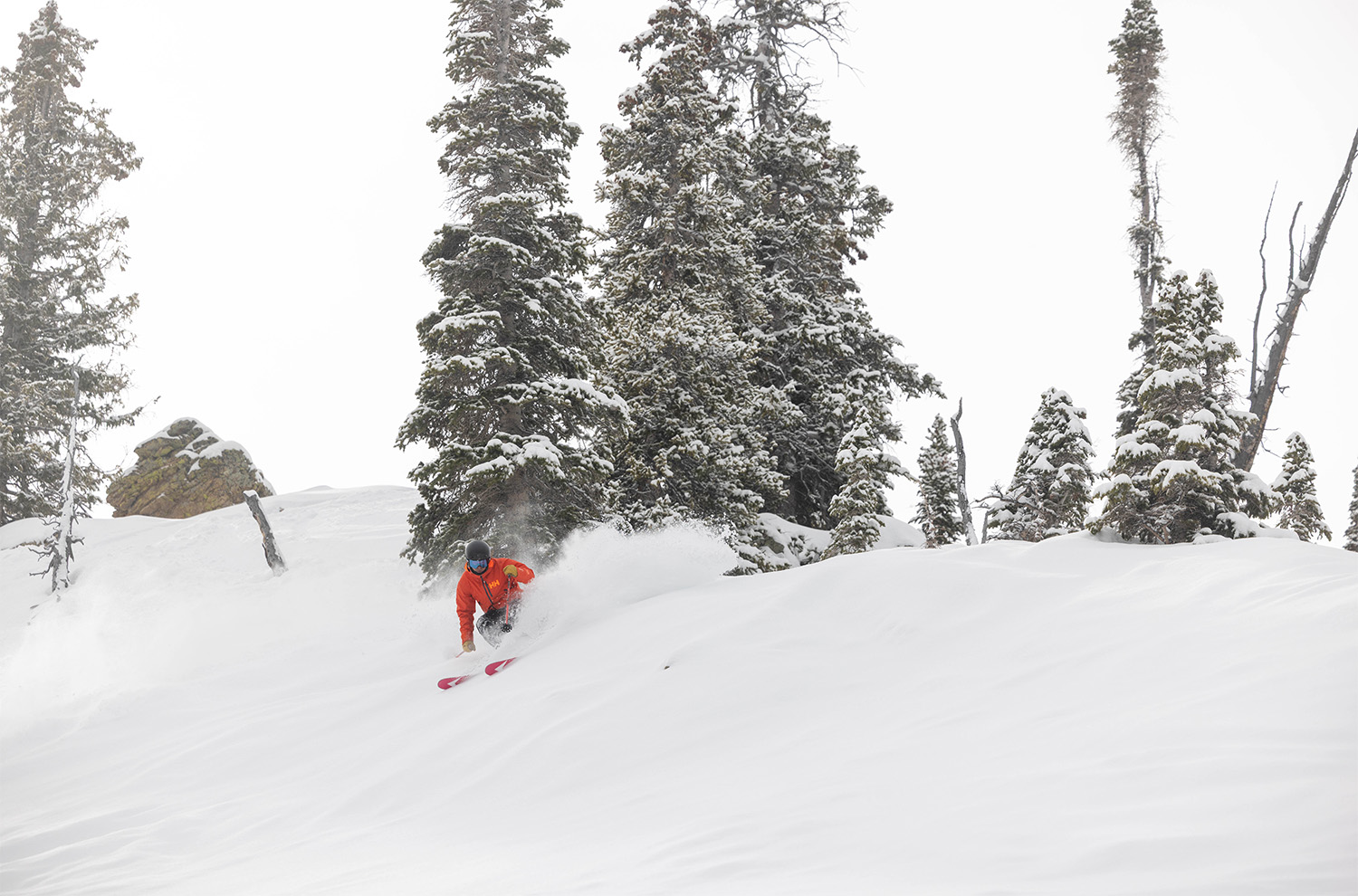
I could ski it with a very centered / upright stance, but I could also drive it hard through the shovels in most conditions. In contrast to my experience with the Rossignol Sender Free 110, I didn’t feel particularly inclined to push the bindings back on the M-Free 112.
And even when I tried the M-Free 112 mounted -1 cm and -2 cm back from its recommended line, I didn’t notice big differences. Pushing the bindings back created a tiny bit more flotation from the front of the ski, slightly increased its swing weight, and made it feel a tiny bit less balanced in the air. But I didn’t end up having a strong preference about whether it was mounted at -3.5, -4.5, or -5.5 cm from true center.
So, my main points here are that (1) the M-Free 112 doesn’t feel as freestyle-focused as its mount point might suggest, and (2) moving back from its recommended mount point doesn’t drastically change the ski.
Jonathan Ellsworth (5’10”, ~185 lbs / 178 cm, 84 kg): To add my two cents on mount point, I’d say that a general sweet spot for me is -6 cm to – 9 cm behind true center, though I’ve also gotten along well with skis that are mounted even farther back. And personally, I’d almost always rather err on the side of mounting a ski a bit farther back than a bit too far forward, because I really dislike the feeling of having too little ski out in front of me.
Given all of that, the craziest thing about the 190 cm M-Free 112 is that I love it mounted on the recommended line, or slightly behind (no preference here).
Powder
Luke: The M-Free 112 is lots of fun in fresh snow. It doesn’t feel like it was purely designed to be the floatiest, surfiest ski in untracked pow, but it does very well for its size.
When skied with a fairly centered stance, I rarely found myself wishing for more flotation than what the 190 cm M-Free 112 could offer (we’ll discuss lengths in more depth below).
In snow deeper than about 12” / 30 cm, the M-Free 112 doesn’t float or slash as well as the discontinued (and much more directional) Dynastar M-Free 118. But, in the past eight seasons, I’ve probably only had a handful of powder days at Crested Butte that were deep enough where I would’ve seriously preferred a bigger ski than the M-Free 112.
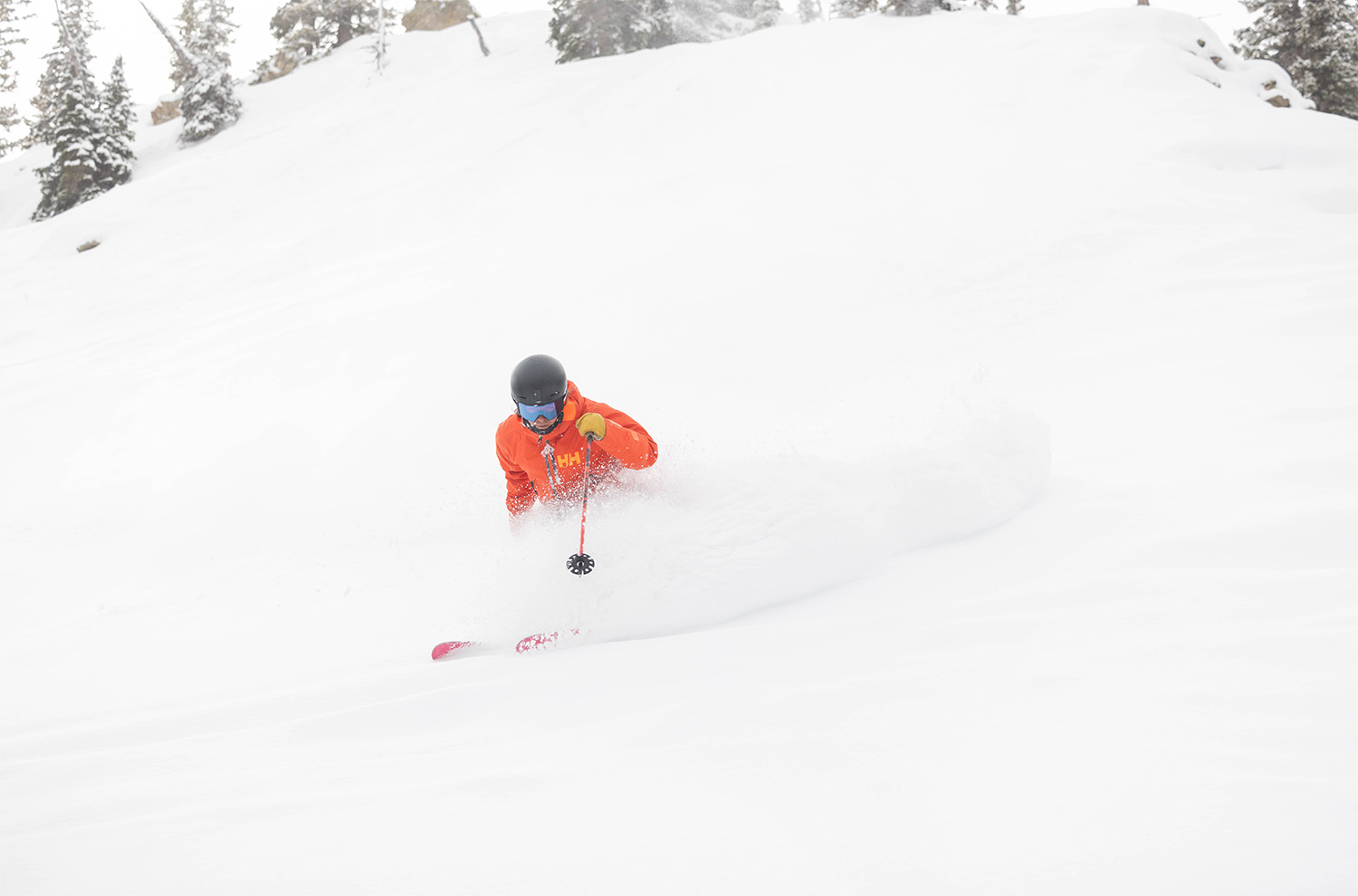
Deep pow, especially in low-angle terrain, is the main scenario where the M-Free 112 has the strongest preference for not being driven very hard through the shovels. I can make the front of this ski ‘dive’ in those cases, but I still rarely find myself having to think about or focus on my body position / balance point on this ski. The sweet spot feels quite large.
The M-Free 112 is also very easy to slash and drift, regardless of conditions. It doesn’t have a low swing weight, relative to the rest of the market, so it does require some physical effort to flick around. But it doesn’t feel like the M-Free 112’s shape or rocker profile are hindrances when I want to transition between a wide variety of carved and skidded turns in soft snow.
All that said, this isn’t the ski I’d pick if I were only going to be surfing through untracked pow. It’s what comes after that really makes the M-Free 112 shine.
Jonathan: I completely agree with all of the above. I wouldn’t pick the M-Free 112 either as my #1 choice if we’re fortunate enough to be skiing lap after lap of untracked, deep pow… but if you are constantly skiing lap after lap of untracked deep pow, feel free to invite me to come ski with you sometime.
Soft Chop
Luke: The M-Free 112 is one of my all-time favorite skis for soft chop — the sorts of conditions that actually make up the majority of my ‘pow days’ at the resort. And there are several factors that contribute to this.
First, the M-Free 112’s weight. At a little over 2400 grams per ski for the 190 cm length, this ski is one of the heavier options in its class. While that doesn’t make it feel very nimble in the grand scheme, it does lend the M-Free 112 phenomenal suspension. This ski does an excellent job of dealing with impacts and vibrations from variable conditions, muting them out better than most of its competition.
In soft chop, I’d wager that the M-Free 112’s shape is also a big factor behind its high-speed composure. Its minimally tapered tips don’t get knocked around very easily, and its moderately long sidecut radius (22 m @ 190 cm) also seems to help keep it tracking in the right direction — whether I’m trying to make big, carved turns or hold an extended, sideways drift in steep terrain.
However, what really sets the M-Free 112 apart from most other similarly heavy and/or similarly shaped skis is how easygoing the M-Free 112 can feel, relative to how stable it is.
Cut-up pow is a pretty forgiving type of snow, and it also creates tons of clumps / mounds, which my lizard brain immediately identifies as takeoffs. I.e., in these conditions, I want to go fast and jump off stuff. And if I’m doing that, I’ll inevitably get a little out of control.
This sort of skiing is what I think the M-Free 112 caters to so well. It’s one of the calmest and most composed skis in its class when going silly fast in soft chop. But it’s still pretty playful, maneuverable, and forgiving for what it is.
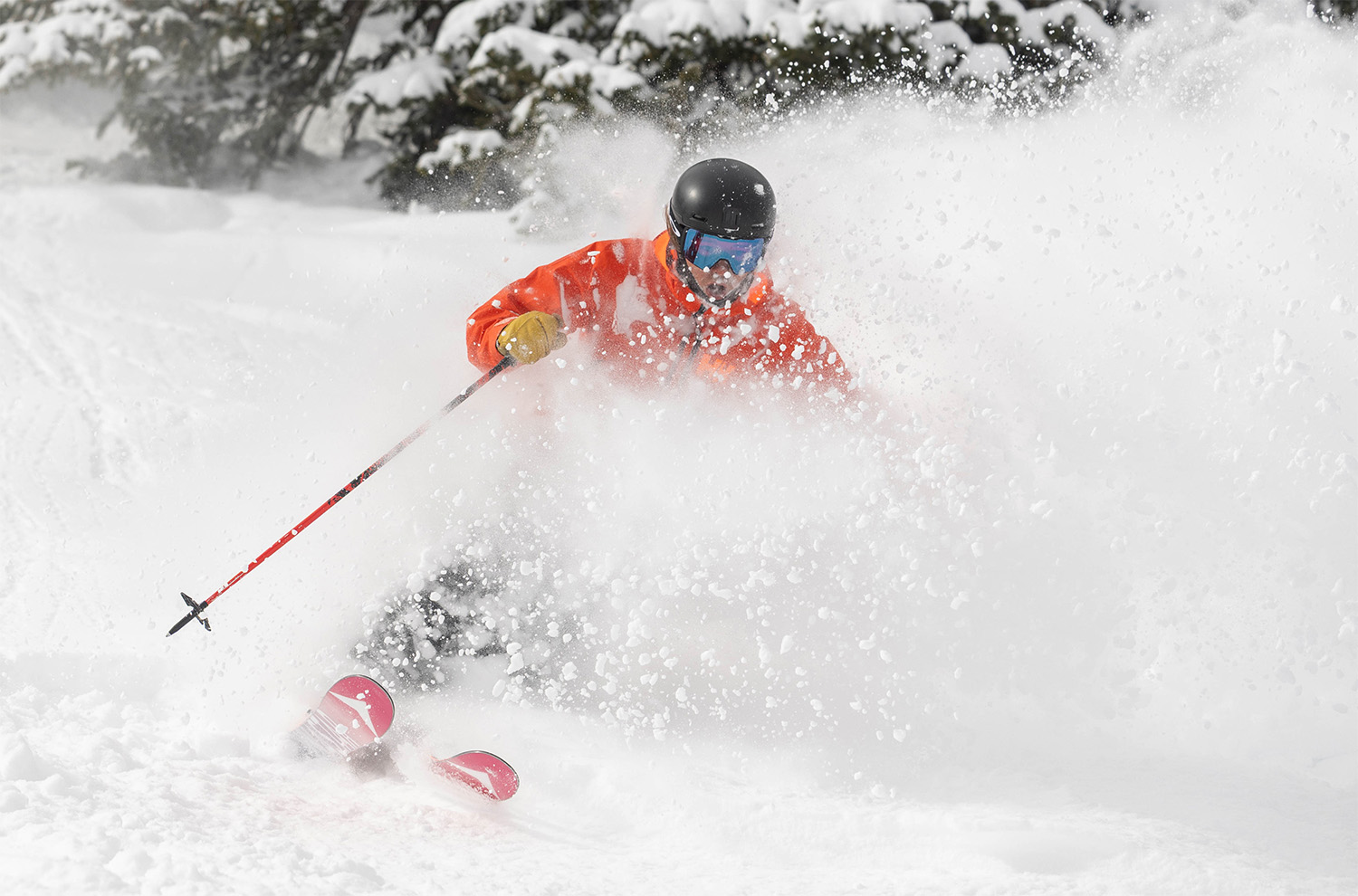
If I get going a bit faster than I want, I can easily throw the M-Free 112 sideways to shed speed. And I can do so from a pretty forward, very centered, or even slightly backseat stance without feeling like the ski is getting away from me. Again, there’s a huge sweet spot on this ski.
Now, avid Blister readers will know that I’ve said very similar things about another ski, the Rossignol Sender Free 118. We go into more specifics about that ski and dozens of others in our Deep Dive comparisons, but in short, I view the 190 cm M-Free 112 as the most apt take on a narrower 186 cm Sender Free 118. I.e., the M-Free 112 actually feels more similar to that ski than the Sender Free 110 does.
Jonathan: Yes, again, to all of the above. Luke is really spot on here, so the only thing I’d add is that where the M-Free 112 also shines is in the transitions from stashes of deeper pow to sections of scraped-off terrain (which can be pretty common when skiing steeper terrain at places like Crested Butte, Taos, Telluride, etc.). In general, lighter skis than the M-Free 112 don’t handle such transitions nearly as smoothly or as calmly as heavier skis. And especially when you’re skiing a steep, fairly (or very) technical line, it’s really nice to not have to worry much about whether that turn you’re about to make on what looks like a soft pocket of snow is actually a rock that is barely being covered up.
Firm Chop & Crud
Luke: Pretty much everything I said about how the M-Free 112 handles soft chop applies here. This ski stands out for being very damp and stable in rough snow. But, compared to the skis that can compete with it in those regards, the M-Free 112 accomplishes this while still being surprisingly maneuverable and forgiving.
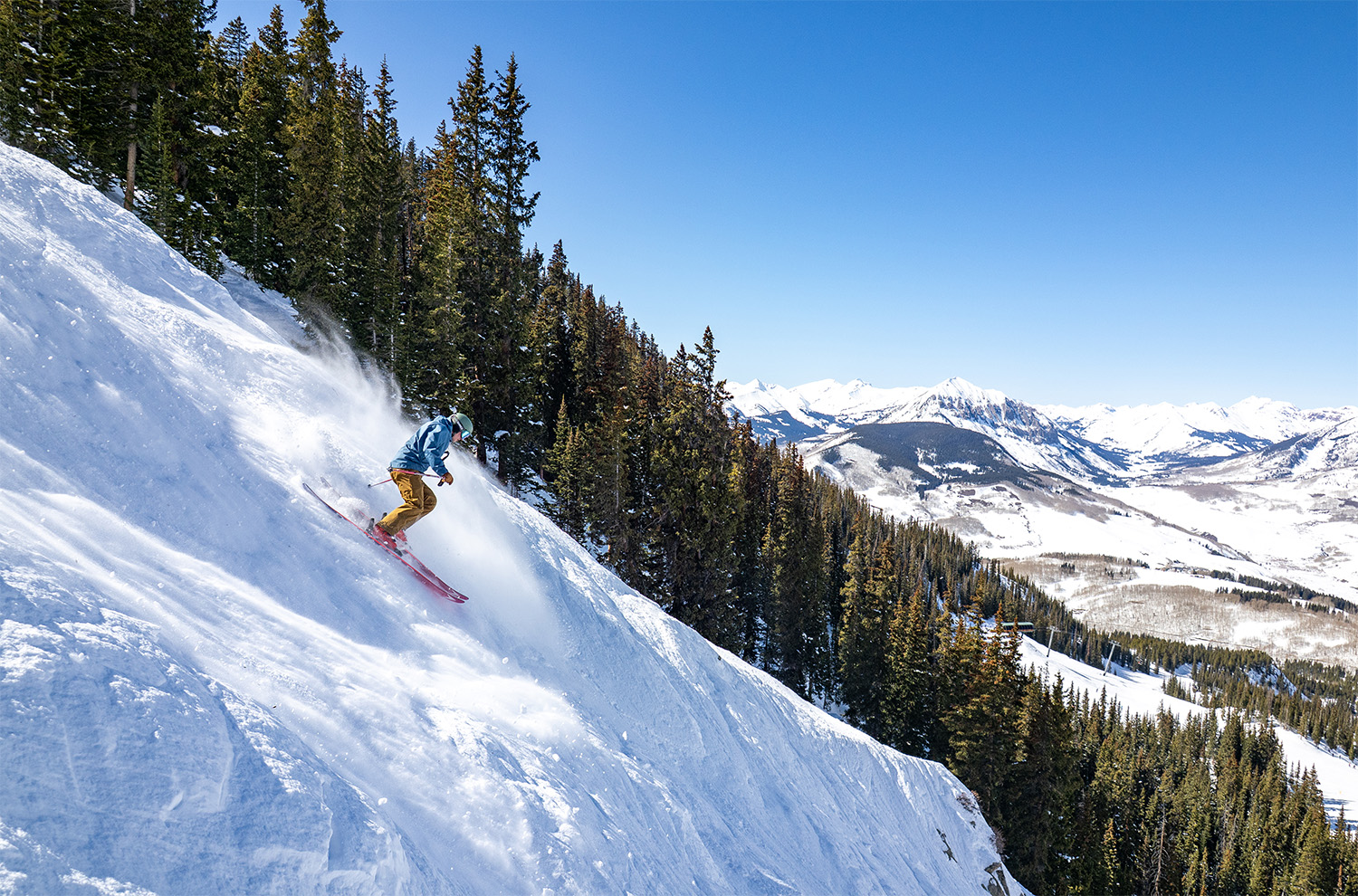
If the snow has some ‘give’ to it, I still very much enjoy skiing this big ski. E.g., a day or two after the latest storm. In those scenarios, I love the M-Free 112 for all the reasons I outlined in the Soft Chop section.
The M-Free 112’s width and weight can start to feel like a bit of a hindrance when the crud gets properly firm. If I had to do a competition freeride run in those conditions, the M-Free 112 would still be one of my top picks. But on a regular day at the resort when conditions are nasty, I tend to dial back my speed and adopt a more dynamic, light-on-my-feet style. There are lighter, more nimble skis better for that approach (such as Dynastar’s M-Free 100).
Trees, Moguls, & Tight Terrain
Luke: For what it is, I really like the M-Free 112 in tight terrain. But it’s important to remember that this is a heavy, pretty wide, and fairly strong ski.
(Jonathan: I just deleted the word “very” in front of Luke’s claim that this is a “very heavy” ski, because … I still truly worry very much about the perpetuation of a ‘light is right’ bias among people who ski and people who design skis. So, for the millionth time here: if you are a skier looking for skis, do not believe that lighter = necessarily better. And if you are a ski designer, please do not feel any societal pressure to make lighterweight inbounds skis. Just make skis that ski great and have great suspension. Hit that, and find out later what the ski happens to weigh. And I’ll promise to keep deleting the word “very” in our ski reviews.)
Luke: What I’m getting at is that, no, the M-Free 112 is not the quickest, surfiest, or most forgiving ski in its class. Far from it. Look to much lighter, more rockered, and/or softer skis if those are your top priorities.
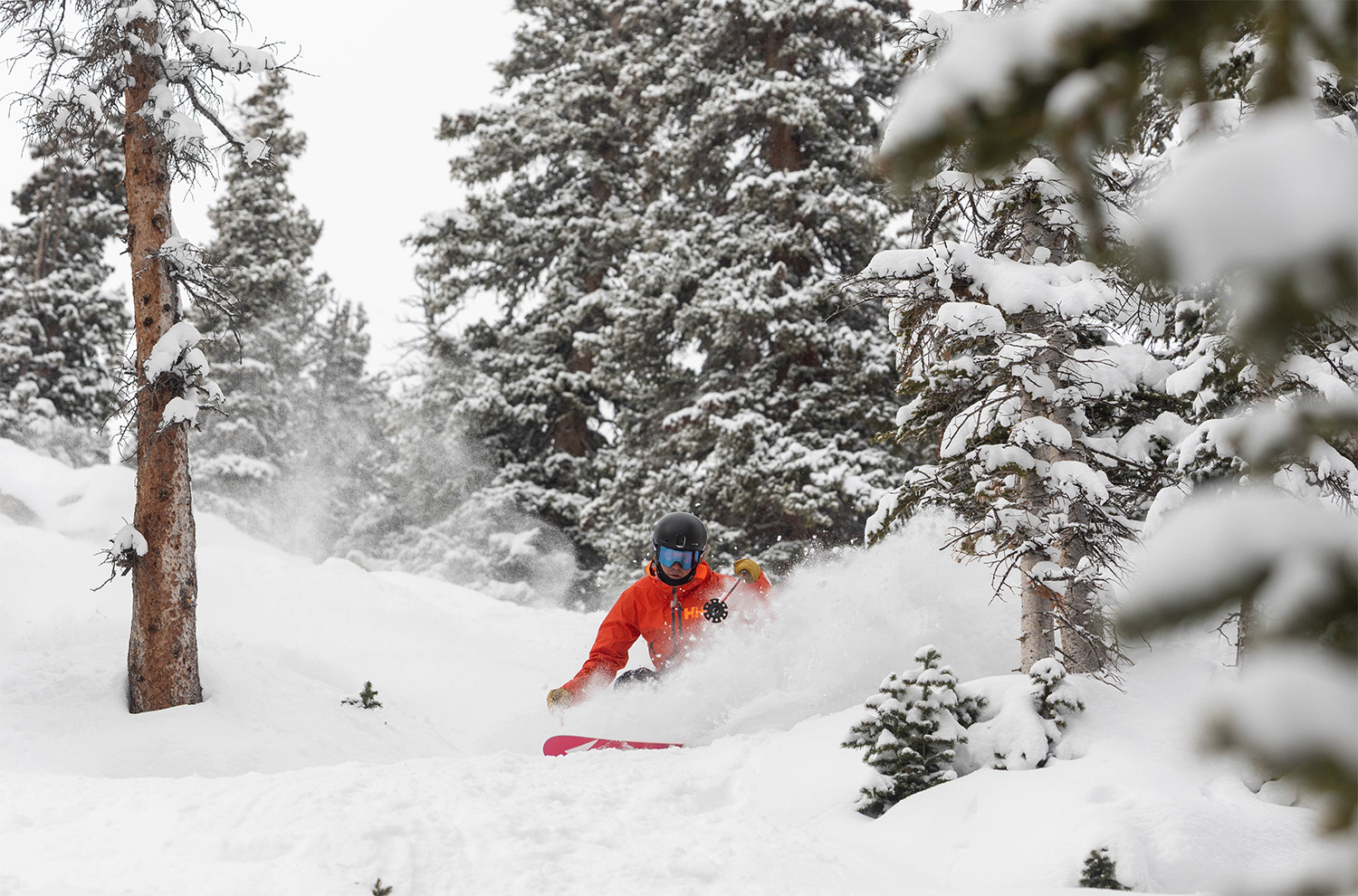
Jonathan: He’s right. And even given my public service announcement above, if you’re someone who prefers to ski at very controlled speeds with very deliberate technique, the M-Free 112 is almost certainly not the best tool for that very controlled style.
Luke: But, again, the M-Free 112 is surprisingly accessible and easy to maneuver in tight spots — when you’re thinking about it in the context of similarly heavy skis that feel similarly stable at high speeds.
Personally, I can have a blast bashing bumps and slithering through trees on the M-Free 112 as long as there’s some soft / loose snow to push around. E.g., on a recent day when we’d only gotten one or two inches of fresh snow, I was still loving taking this ski down tight moguls in these ‘dust on crust’ conditions. And my Carv data informed me that I was skiing these bumps nearly as well (Ski:IQ score of 150) as I could on notably lighter and narrower skis (so far, my best Ski:IQ in moguls this season is 155).
Momentum also helps; as long as I keep the ski moving just a bit, it doesn’t strike me as wildly sluggish. Its swing weight feels a good bit lighter than its actual weight would suggest, and its tails are easy to release into skids and pivots. In true hardpack conditions, I prefer something narrower and lighter in tight terrain.
Jonathan: Yep, the M-Free 112 wants some momentum. What’s remarkable about this ski, however, is that it does not require a ton of speed to come alive, but the faster you tend to ski (and the less your style is to pick your way down the mountain with very deliberate, controlled turns), the more confident I am that you will like this ski. And the other cool thing: if you are someone who absolutely loves to pin it, I highly doubt that there will be many skiers out there who will feel that they need more ski than the M-Free 112.
Groomers / On Piste
Luke: I don’t think carving performance is a big priority for most people in the market for a ski like the M-Free 112, but it’s worth briefly touching on. The M-Free 112 is not a great carver on firm snow. It’s predictable to skid around and can be enjoyable to carve pretty big turns on when the groomers are soft. But it’s not the ski to get if you want your ~110mm-wide freeride ski to be particularly good on piste.
Jonathan: Yep. It will get you back to the chairlift just fine, but it’s not going to be in contention for best ~110+ mm wide carvers.
Playfulness
Luke: The M-Free 112 is definitely not the most ‘playful’ in its category. There are lots of other skis that have lower swing weights, are easier to bend, that feel more lively / energetic, etc.
However, the M-Free 112 is still a very freestyle-friendly ski. In particular, it feels very well suited to modern freeride skiing, which typically involves high speeds, big turns, and unpredictable snow, but also lots of air time and tricks.
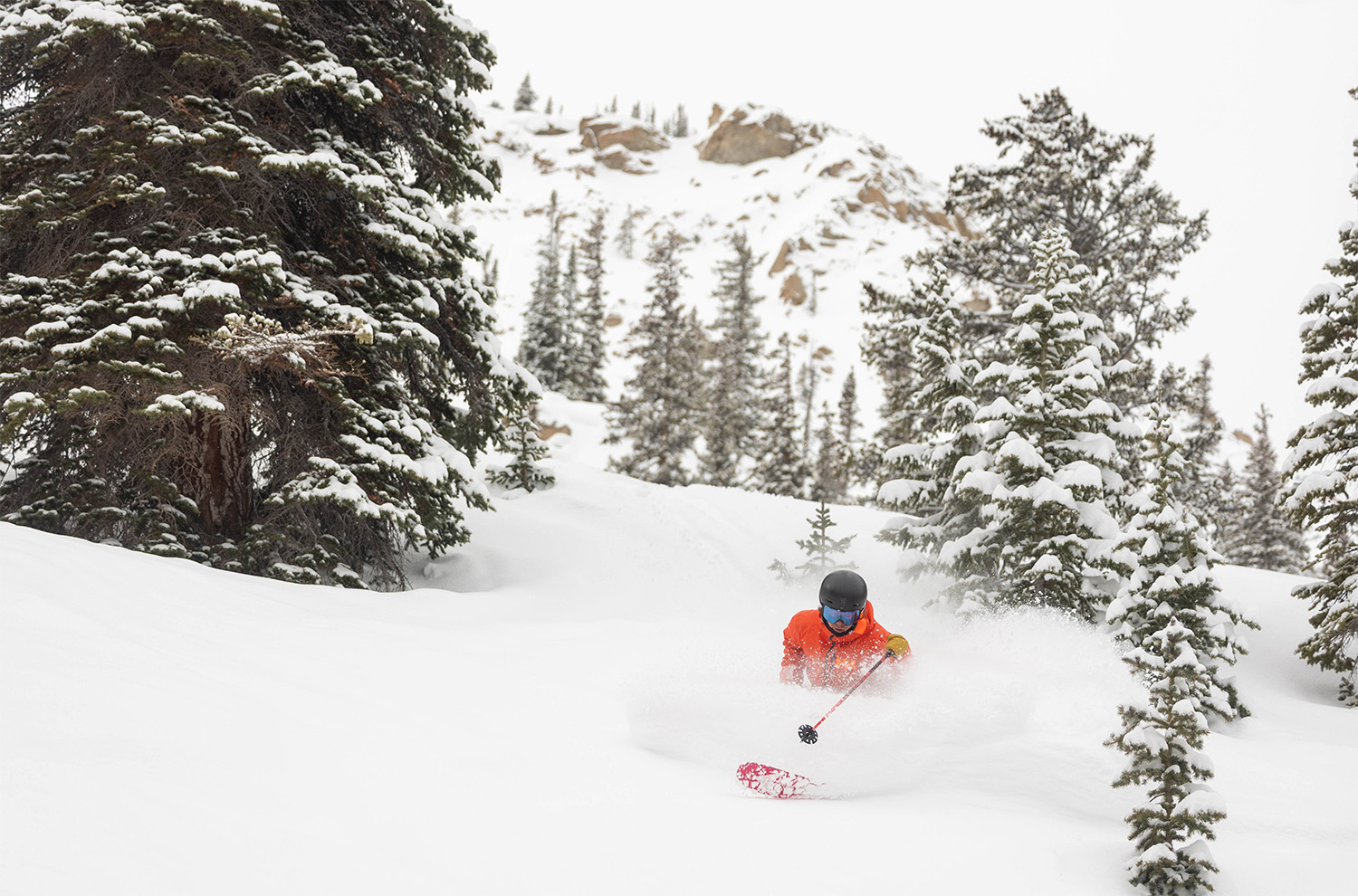
While not light, the M-Free 112 does feel balanced. It takes off and lands switch well, and it provides an excellent landing platform (very supportive through the middle but with a bit of ‘give’ at the tips and tails).
Don’t get the M-Free 112 if you want to maximize playfulness at slow speeds. But it’s an excellent option if you want to jump off a bunch of stuff at faster paces.
Lengths
Luke (5’8”, 155 lbs / 173 cm, 70 kg): For reference, I tend to get along with most ~110mm-wide skis in lengths spanning from roughly 184 cm to 192 cm, depending on the particular model. In the case of the M-Free 112, I strongly prefer the 190 cm length over the 183 cm. I think a lot of this has to do with its mount point, and the conditions I tend to ski on a ~110mm-wide ski.
As I noted above, the 190 cm M-Free 112’s swing weight feels lighter than its on-paper weight suggests, and a big part of that comes down to its mount point putting you near the middle of the ski. It’s also pretty forgiving for what it is.
Since I typically use this sort of ski when there’s at least some sort of soft snow to be found — conditions where I value flotation and stability — those traits combined to make the 190 cm M-Free 112 the right length for me. I got along well with the 183 cm in shallower / firmer snow, but I was wishing for more flotation and support from the front of the ski in powder and soft chop deeper than ~6” / 15 cm.
So, if you’re someone who’s caught between lengths, I think sizing up will be the right call in most cases.
Jonathan: There are lots of skis where I can pretty happily ski one or two lengths of the ski. But the M-Free 112 is not one of them. I am squarely in the 190 cm camp here. For me, the 183 cm gave up too much stability on my personal-and-certainly-subjective ratio of stability to pivotability. With that said, I’d love to hear from people who are happily skiing the 183 cm M-Free 112 — what is your height & weight, where are you skiing, etc.
Who’s It For?
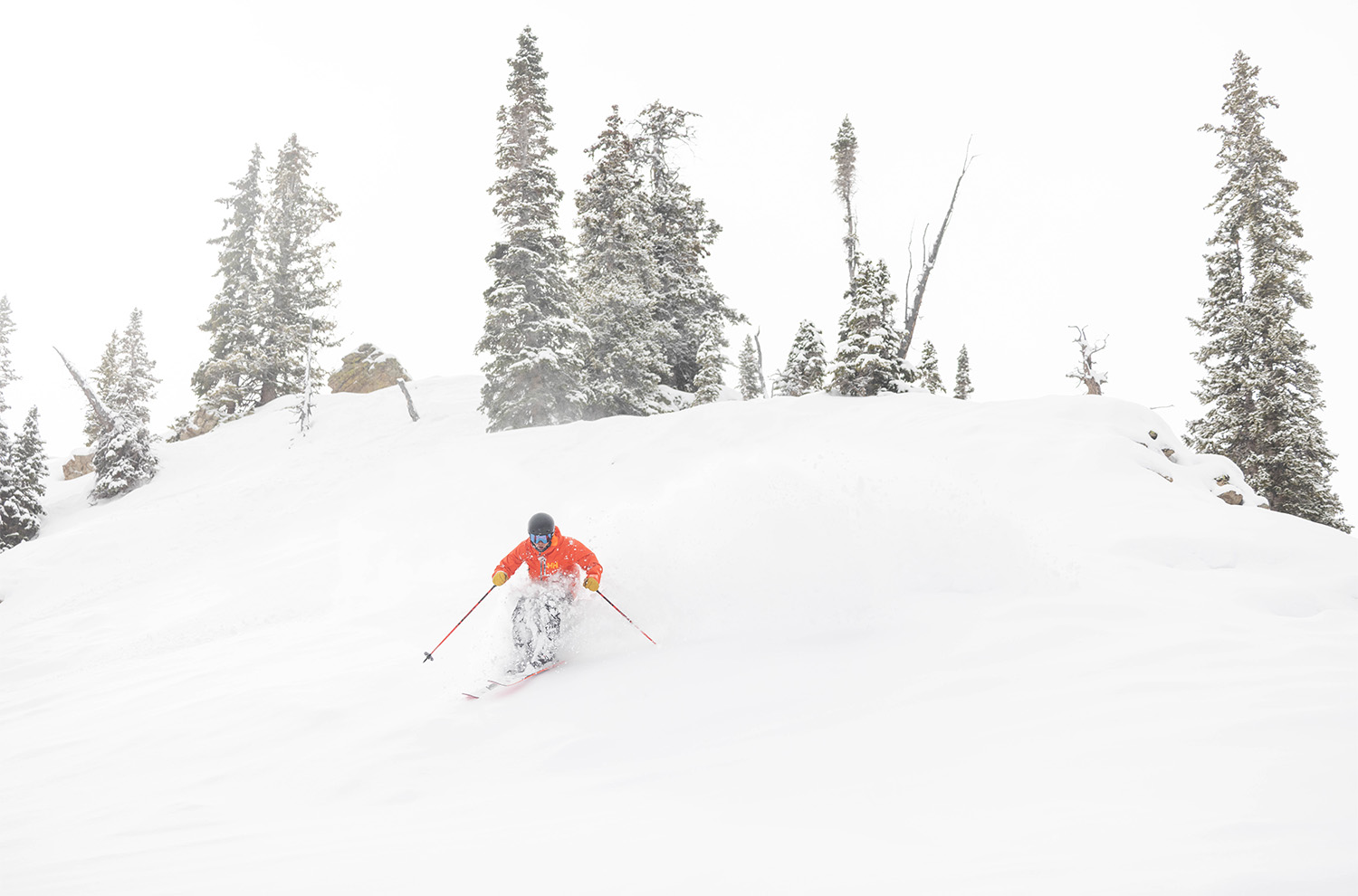
Advanced and expert skiers who want a very damp and stable ski for soft and mixed conditions, but who don’t feel drawn to very directional, more traditional big-mountain skis.
Don’t get the M-Free 112 if you prioritize quickness or low-speed playfulness more than high-speed composure. It’s also probably not the best bet if you’ve always skied (and loved) very directional skis with very rearward mount points.
But this is an outstanding ski for folks who want a soft-snow ski that (1) isn’t easily unsettled by chop and crud and (2) isn’t quick to punish mistakes when you’re on the limit and get a bit off balance. It’ll be even more appealing if you fit those criteria and you like to get in the air often and/or throw some tricks.
Bottom Line
Dynastar’s M-Free 112 offers a very rare blend of chop-erasing suspension, reliable stability, and freestyle-friendly forgiveness. And it does so while catering to a surprisingly wide range of skiing styles and stances. Dynastar absolutely knocked this one out of the ballpark. The only question is whether or not this is the best tool for you, given how and where you ski.
Our Deep Dives, Winter Buyer’s Guide, & Flash Reviews
BLISTER+ members and those who purchase our Digital Access Pass can check out the Deep Dive comparisons linked below, where we compare a given ski, bike, etc. to a whole bunch of other comparable products in its class. Don’t have access? Get our Digital Access Pass to read all of our Deep Dive comparisons, as well as our Flash Reviews, where we provide our initial impressions as soon as we start testing gear.
Or, even better, become a BLISTER+ member to get that + the best worldwide Outdoor Injury Insurance, exclusive deals and discounts on skis, personalized gear recommendations from us, access to our annual Winter Buyer’s Guide, and much more.
On that note, you can also get our thoughts on this ski and 350+ others in our annual Blister Winter Buyer’s Guide. BLISTER+ members already have access, or you can purchase the guide on its own to get the the print copy + digital version at no extra cost, or the digital-only edition.
Deep Dive: Dynastar M-Free 112
We compare the M-Free 112 to the Dynastar M-Free 108, Rossignol Sender Free 110, Dynastar M-Free 118, 4FRNT Sinister, Moment Wildcat 118, Volkl Revolt 114, Dynastar M-Pro 108 Ti, ON3P Jeffrey 108, Prior Northwest 110, Icelantic Nomad 112, Salomon S/Lab QST Blank, Heritage Lab AM110, Head Kore 112 Ti, RMU Professor 111, Atomic Bent 110, K2 Reckoner 110, DPS Koala 111, Faction Studio 3, Moment Deathwish 112, Folsom Giver, Moment Countach 110, & more.
Blister’s Flash Reviews and Deep Dives are accessible to those who purchase one of our paid subscriptions
To get our comprehensive Deep Dives and our initial, unfiltered reports on new gear, become a member and receive many other services, deals, and discounts.
If you’re already an active member, please log in.
(If you’re already logged in and a member in good standing and seeing this message in error, please refresh this page in your browser.)
2025-2026 Blister Digital Winter Buyer’s Guide
350+ skis, 70+ boots, and 280+ pages of honest, accurate product reviews and comparisons. Check it all out here.
If you’ve already purchased the guide, Digital Access Pass, or BLISTER+ membership and are seeing this message, please log in and then refresh this page.
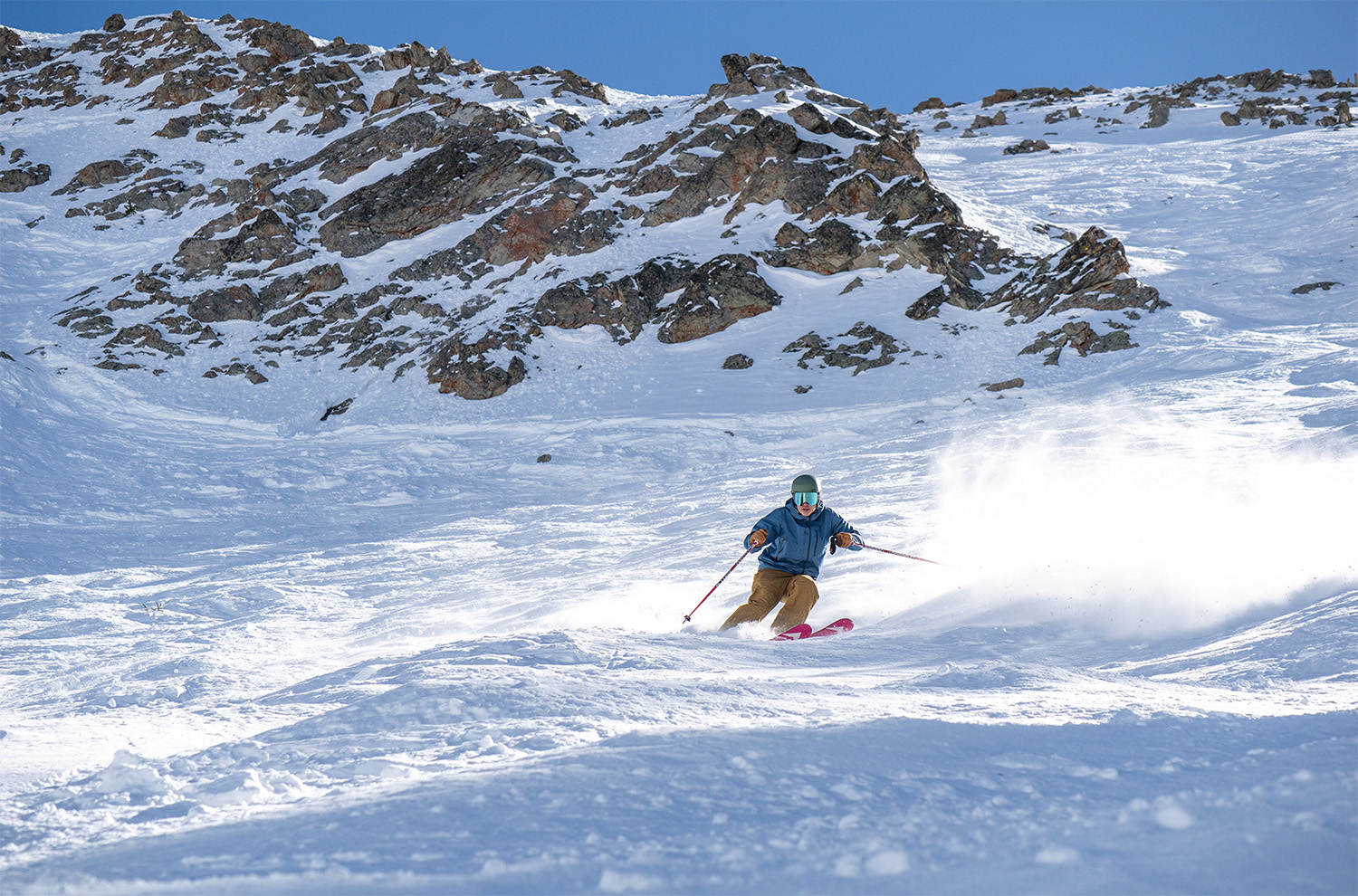
Flash Review: 25/26 Dynastar M-Free 112
Update: Luke Koppa has added more thoughts on the 190 cm M-Free 112, how it compares to some other skis in its class, and why it’s quickly become a favorite of several of our reviewers.
Blister’s Flash Reviews and Deep Dives are accessible to those who purchase one of our paid subscriptions
To get our comprehensive Deep Dives and our initial, unfiltered reports on new gear, become a member and receive many other services, deals, and discounts.
If you’re already an active member, please log in.
(If you’re already logged in and a member in good standing and seeing this message in error, please refresh this page in your browser.)
Looks like an enforcer 115 but with a WAY better mount point. Nice.
I bought 190 M-Free 112’s this year in an effort to try and find a “longer Black Ops 118″… Skied em a bunch of days in all conditions and I’ve already sold them. While I recongnize they are great skis for a buch of people, they definitely did not click with me… I’m 6’2”, 200lbs so my main issue is that I don’t get enough fore/aft stability when I’m up to speed in rough terrain on the BO118. Sure enough, the longer M-Free’s were a bit better for high-speed rampaging in chop, but aside from that, there wasn’t a single thing they did better than the Black Ops 118. I detuned them significantly, and that definitely helped, but they were somehow still less loose AND less precise than the Black Ops and about 40x more cumbersome in techy situations. I’m in SE BC & ski a lot of steep & deep trees, pillow’s etc, and have a pretty slashy style, so maybe I just click better with a shorter and more rockered ski? But these things are LOCKED in compared to the Black Ops with pretty much zero upside unless your running at high speeds in wide-open terrain.
Definetly try before you buy!
Hi, Bob – this almost might sound like an insulting question, and I don’t at all mean it to be: but when you say you were hoping that a 112mm-wide ski would perform like a slightly longer 118mm-wide ski … that sounds like a bit of a rather serious category mistake, no? Sounds like – given your height, weight, and where you’re skiing, you actually do need a longer Black Ops 118, or something like the 191 cm, 121mm-wide 4FRNT Renegade?
I’d also have to say, given that Luke and I have only skied the M-Free 112 at a place that is not at all known for its wide-open terrain, it hasn’t at all been our experience that, “these [skis] are LOCKED in compared to the Black Ops with pretty much zero upside unless your running at high speeds in wide-open terrain.”
I’ve heard that the 183 at -3 from recommended is great for increased float and dampness without a negative effect. The sidecut centre of the ski is at -7 from centre…
I don’t think there is a category mistake Jonathan. The pow ski slot is already covered so I don’t actually use l the black ops for pow. They are too short & centre mounted for that. The black ops are more of an “all mountain” ski for me. ‘Round these parts, firm and ice are more of a rarity, so the black ops actually come out the day or two after the storm, and I’ll usually just keep skiing them until the next storm rolls in. A 112mm ski should easily take care of those duties too, but alas I found the m-free 112 to be pretty one-dimensional (go fast & rampage without much turn shape variation) relative to the black ops. The black ops also rampage (albeit to a slightly lesser extent for a taller person), but they still pivot, surf, slarve, bounce, slash and will make any turn shape on demand which I simply couldn’t get the m-free’s to do.
I simply can’t think of a single day or condition where I’d reach for the m-free 112’s over the black ops, unless it was absolute boilerplate or unless for some reason I was only going to do high-speed long radius turns down choppy, open runs.
How’s the tune? Bases true / edge high?
Good in pow, stable in chop, decreasing fun as the snow gets harder, flatter, and wider. Sounds a bit like the old Bibby, no? Or am I misreading something?
Bob’s set of MFree 112 seem to exhibiting the classic Edge high/railed base symptoms of “stuck in a turn, slower edge to edge, harder to pivot and more demanding and heavier feeling”. Blanking grind to flatten the bases and a re-tune of the edges will cure the issue. Had the same issue with my Sender Free 100 and all my Enforcers.
Had the opposite issue with all my Blackops 118, SF 110 and MFree 112 that were all base high and over bevelled. Felt unstable, had poor edge grip and like you were skiing on marbles.
The 190cm MFree 112 should feel like a faster edge to edge, more stable BO 118 if they are mounted in a similar spot. Going to feel longer because it is but should feel plenty playful even mounted back for someone 6’2”/200. With a new tune I think you’d like it more.
Had the 184cm SF 110 and now 183cm MF 112 as my “bit of new snow, tight trees” type ski and it’s perfect for my needs. Between new Enforcers 104 and Blackops 118(-2.5cm back/5cm total back) and find it a great “narrower BO 118”.
I’m 6’2”/175 and originally had almost identical dimensions and shaped 21 Faction CT 3.0 and their middle “Progressive” mount was -6.5cm total back and loved my 184cm and 190cm versions mounted there. I mounted my 184cm Sender Free 110 and now MFree 112 about -3cm/-6.25 total and it’s perfect for me.
Playful, stable with good float and fantastic carvers even in firmer conditions after a new tune. Skis exactly like a mini 186cm 118 and like the improved damping on the MF 112 vs the SF 110 which I also loved.
Agree the MF 112 is more narrow Blackops 118 than the SF 110 with its rubber layer in the tips instead of AirTip and the Hybrid core.